Overall, in the present study, PB and MP products contained more carbohydrates, sugars, and fibre, compared with meat products, whilst the energy, protein, fat, and saturated fat content of PB and MP alternatives was significantly lower than that of meat products. Additionally, PB and MP alternatives were significantly more expensive than meat products. Moreover, our analysis highlights the impact of this declared nutrient composition on potential dietary intake across different population age groups.
The energy composition varied significantly between ME, PB and MP alternatives and more specifically, between B&H, B&K, CT&D, and SAU, leading to corresponding changes in energy intake across age groups. For some product categories (B&H, B&K), replacement of meat with PB and MP led to reductions in the energy intake for all age groups, confirming results of other studies5,26,27,28. However, in contrast, PB CT&D had a significantly higher energy content, resulting in increased energy intake for every consumer age group. Similar findings by Zhang et al.29 highlighted the variation in the energy profile of products. When ME from the five product groups is combined and substituted with PB and MP products in the NDNS dataset, it results in significant overall differences in energy intake across all age groups. However, this is primarily due to MP, as when ME is substituted with MP, the contribution to EAR is reduced by between ~20% and 30% depending on the age group. However, when ME is substituted with PB, the energy intake did not change. These results indicate that the reduction in energy intake by switching from meat to PBMAs cannot be assumed across the board but depends on the meat category and the corresponding PBMA.
Obesity is prevalent across all age groups in the UK, and causes 31,000 heart and circulatory-related deaths every year30. Hence, lower energy consumption from certain PBMAs, particularly MP, replacing specific meat types (e.g., CT&D) can be considered beneficial. But this may not be the case when sausages are substituted by PBMAs. Evidence has shown that switching to PBMA after consuming meat for a period of time is linked to improvements in indicators of cardiovascular disease risk factors, such as lower LDL-cholesterol concentrations and body weight31. Additionally, studies support our findings, showing that PBMA, compared to ME, contains higher amounts of fibre, which increases satiety and may support weight maintenance32. Potential improvements in lipoprotein profiles, cholesterol, and triglyceride levels were also observed following PBMA consumption compared to ME, which may be linked to this increased fibre content33. In accordance with previous studies, Fernández-Rodríguez et al. concluded that PBMA consumption improved total cholesterol, LDL-cholesterol and body weight34. Taken together, this research highlights the potential benefits to cardiovascular disease risk when certain meat alternatives are consumed in place of meat.
Children and older people are considered vulnerable population age groups, as their well-being is often fragile and they are more susceptible to malnutrition, while their energy and protein requirements are increased35,36,37. In the 1.5–3-year-old age group, where meat consumption makes up a substantial amount of their daily energy intake (9.52% of their EAR), replacing ME CT&D with PB CT&D would increase their EAR significantly (to +0.67%). Similarly, for adults 75+, moving from ME to MP would decrease %EAR from 5.04% to 3.70% at an age where increased intake of calories is generally required. All the PBMA contained less protein compared to meat. Consequently, this leads to a decreased contribution to RNI of between 3.4% and 15.1% of RNI. These findings comply with a plethora of other studies highlighting a shortfall in protein content of PBMA26,27,38,39. This is of particular relevance to children and older adults, where an adequate intake of high-quality protein plays a pivotal role in growth and health40. Proteins contribute to the development, maintenance and repair of children’s bodies, while older adults are at risk of sarcopenia due to the progressive loss of muscular mass, strength, and function that occurs with aging40. Guidelines for dietary protein recommend 0.8 g/kg body weight/day for healthy adults, 1–1.2 g/kg body weight/day for older adults or 1.2–1.5 g/d body weight/day for older people who are malnourished or at risk of malnutrition to sustain their muscle protein synthesis36. From the NDNS dataset, adults over 75 years of age obtain 18.9% of their protein requirements from meat sources. With the substitution of PB and MP, only 12.9% and 10.6% of their protein requirements would be met through these sources. Considering that most PB sources lack essential amino acids and fail to cover the protein demands of older people, PB meat alternatives might not be a suitable protein source for older people41. More specifically, 80–95% of plant proteins are usually digested in the human gastrointestinal tract (GIT), instead of 95–100% of meat proteins. Hence, with the same overall total protein intake, people may receive less protein from plant-based foods than from animal-based ones42. Additionally, plant-based proteins lack a complete essential amino acids profile, and the high level of processing in PBMA can hinder amino acid absorption by disrupting plant cell structures42. A potential solution to this issue could involve combining proteins from various plant-based sources and improving processing methods to enhance the nutritional quality of these products39,42.
There were significant differences in the total fat and saturated fat content between PBMA and meat. Across all meat categories, both PB and MP had lower fat and saturated fat content than ME, with the exception of PB CT&T and CT&D, which had a similar total fat to ME but still had a lower saturated fat. This has consequent impacts on contributions to intakes across age groups. These findings agree with other studies indicating that the majority of PBMAs have a lower fat and saturated fat content27,29,43. However, findings from McClements and McClements42. demonstrated that PB nuggets contained less fat and saturated fat than chicken meat. This contradicts our results, which found that PB CC&T and CT&D were similar in total fat content to that of ME, and work by Lindberg et al. that found that ME chicken products had significantly lower saturated fat44. This highlights the differences between countries and studies depending on the products available in different markets. Daily intake of saturated fatty acids exceeds recommendations in the UK for adults aged 65 years and over, which is linked to elevated LDL-cholesterol levels and consequently risk of development of CVD45,46. As such, replacement of saturated fat with unsaturated or polyunsaturated fat, plant-based protein and complex carbohydrates could have a positive impact on minimising the risk for CVD development47. Substituting ME with PBMA resulted in a reduction in dietary saturated fat intake, which accounted for 2.58% for PB and 3.04% for MP. The literature suggests a reduction or replacement of 5–6% of daily energy from saturated fat with other nutrients in order to see an improvement in blood lipids30,48, meaning these differences are likely to have a negligible impact on human health.
It is noteworthy that all PBMAs contain higher amounts of carbohydrates and fibre, with PB products also containing more sugar. However, there was some variation with product type PB CT&D containing more carbohydrates, which resulted in three times the contribution of carbohydrates to intake recommendations across age groups. A higher amount of carbohydrates in ME CC&T products is owed to the existence of breadcrumb42; however, this was still lower than PB and ME options in this category. The current study confirmed the higher sugar content of PBMA observed across a number of studies28,42,43; however, this was not found so consistently or overall for MP products. Added sugars in refined food products have been correlated with cardiovascular, metabolic and mental disorders49,50. However, since meat does not contain free sugar, its contribution to intake guidelines was not completed in this analysis.
Significant increases in fibre intake were observed following meat substitution with PBMA. ME substitution with MP product resulted in a 7–10 times greater intake of fibre across all age groups. Moreover, products from MP contained the most fibre in all food categories other than B&K, in which PB ranked first. Dietary fibre has a significant impact on lowering serum total and low-density lipoprotein (LDL) cholesterol concentrations, and the glycaemic index of foods, both in adults and children. Therefore, higher consumption of fibre can decrease the prevalence and risk of cardiovascular disease, type 2 diabetes, breast and colorectal cancer51,52. Since most people in the UK fail to obtain a sufficient intake of fibre from their diets, it is critical to increase their intake. UK guidelines propose intakes of between 15 and 25 g/d for children above 2 years of age, for adults, the recommended intake of fibre is 30 g/d53. Moving from ME to either PB or MP across the diet could have a significant impact on achieving the recommended intake. For example, in the 11–18 years old age group, meat provided 2.72% of the RNI of fibre, where moving to PB increased this to 17.43% of RNI and to MP to 21.53% of RNI. Consequently, both PB and MP versions with a high fibre content would be beneficial for consumers’ fibre intake. Similar findings highlighting the high fibre content of PBMA have been consistently reported across previous studies24,26,27,29,43,44. As such, PBMA can be a beneficial dietary choice for consumers looking to increase fibre in their diet.
From the results, the salt content did not differ significantly among products; however, it was significantly different between all types of product categories. For B&H and SAU, the salt content in ME was highest. However, for B&K and CC&T, the MP and PB had the highest salt content, while the PB CT&D contained the highest amounts of salt. In the 1.5–3 years old age group, substitution of ME with PB CT&D would increase salt consumption by ~8% as a percentage of requirements, while substituting ME with MP would increase salt intake by 3.5% of requirements. Mixed results were presented from other studies with majority, but not all21, showing that PB products had a higher salt content than meat24,26,27,28,43,44. Foods are considered to be high in salt if they contain above 1.5 g/100 g of salt54. Mean PB salt content, which was 1.44 g/100 g (P < 0.01) would be considered moderate in salt content, however the highest of the categories was ME B&H with 3.32 g/100 g. Excessive dietary sodium intake could lead to increased levels of blood pressure, incidence of hypertension, but also the morbidity and mortality due CVD55,56; however, on average, in the current UK PBMA product market, a high salt content does not appear to be an issue.
In agreement with previous research26,27,39,43, our results revealed that all PBMAs were more expensive than all meat products and might not be affordable to a typical UK household. Prices of PBMA can be 38-73% more expensive than their meat equivalents per 100 g, and younger age groups tend to have more limited spending capacity22. This has been attributed by manufacturers to the lower sales volumes and therefore small production runs, as well as stricter technical precautions associated with vegan products57. Depending on the foods consumed, regular consumption of PBMA can have a high monetary cost to consumers.
The nutritional composition of PBMA varies considerably across product categories due to different ingredients and is significantly different from ME. Plant-based diets have been found to be healthier than consuming meat; however, this may not be the case when large amounts of PBMA are substituted, as most of these foods are considered ultra-processed, which is linked to harmful health effects38. The addition of artificial colourings, excessive sugars, and salt (in some products) in an attempt to enhance and mimic meat’s taste, texture, smell and appearance could lead to obesity and other comorbidities25,58. PBMA are also lower in many micronutrients of interest, such as iron, vitamin B12, zinc and omega-3-fatty acids, and the digestibility of plant foods is generally lower compared to foods derived from animals, reducing absorption of micronutrients42. It is, therefore, critical to recommend cautiousness in daily consumption of PBMA.
In contrast, however, plant-based alternatives have been demonstrated to have a lower Nutri-Score due primarily to the higher quantity of fibre in the products28. The health benefits of fibre have already been mentioned, but most importantly, a healthy gut microbiome is strongly associated with foods rich in fibre42. Thus, a healthier microbiome was observed when participants consumed five plant-based meat alternative meals in a week rather than meat meals59. Another asset of plant-based alternatives is that they have a small environmental impact with lower greenhouse gas emissions. There is a significant difference in CO2 emissions between meat and plant-based foods, with the former having the most26 and consumption of plant-based foods may play a significant role in transitioning towards sustainable diets.
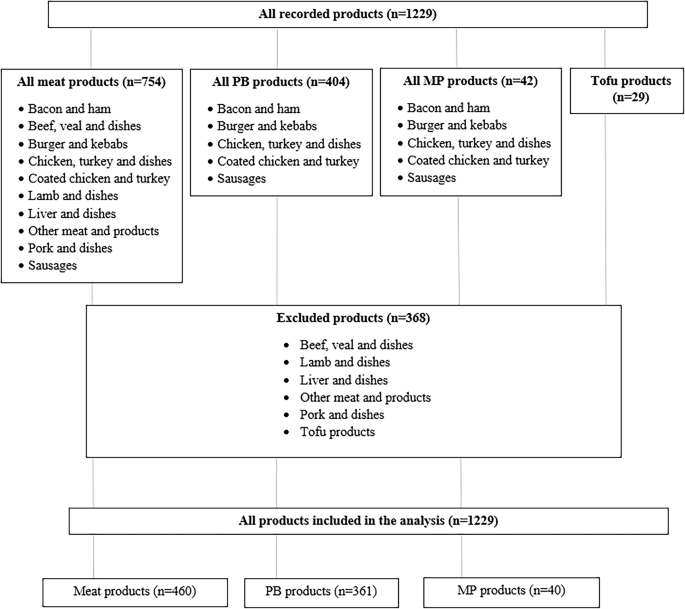
The current study provides findings from the largest database of plant-based meat alternatives and meat comparison products recorded in the UK; however, it is not without its limitations. This study was conducted between July and December 2021; thus, prices, along with the existence of products, might have changed. Due to the abundance of data already reported in this paper, NDNS meat categories with less PB or MP equivalent products were excluded from this study, including ‘Beef, veal and dishes,’ ‘Lamb and dishes,’ ‘Pork and dishes,’ and ‘Liver and dishes’, and fish products. Moreover, meat products were collected only from two supermarkets, as there is a substantial overlap in the types of meat products available across different supermarkets. However, we recognise there may be variations in food composition based on country of origin, type of meat cut and animal species, and across brands. In the present study, only product label data were included, and micronutrients were not examined, as it is not mandatory to declare micronutrient content on-pack in the UK unless the product has been fortified or makes a micronutrient-related claim. Certain models of nutrient profiling showed that micronutrient content, including zinc, iron and B12, changed when substitution is made5,24,25. Additionally, the annual sales value of plant-based meat substitutes in the UK has seen a decrease by 2.8% between 2022 and 2023, indicating a decline in consumer engagement with these products; as such, the implications for this work may be reduced if this trend continues9.
In conclusion, PBMA cost almost twice as much as ME products, have lower energy, protein, fat, and saturated fat content than ME. On the other hand, they are rich in carbohydrates and fibre. Differences did exist between product categories and between PB and MP products; therefore, it is important to pay significant attention to product labels and nutritional requirements in different age groups when substitutions are made.
Future research should consider the impact of substituting ME products with PBMA on a wider range of nutrients, including micronutrients and the impact on population health outcomes and environmental sustainability. In particular, additional studies are needed to assess the effects of PBMA consumption on established health biomarkers, blood pressure, and body composition. Concurrently, comprehensive life cycle assessments should quantify the environmental impacts of PBMA production and consumption, including greenhouse gas emissions, land use, and water footprint. Such multidisciplinary research is essential to determine whether PBMA offers meaningful advantages over traditional meat products, providing a more holistic understanding of the potential benefits and trade-offs associated with a dietary shift from animal-based to plant-based protein sources.