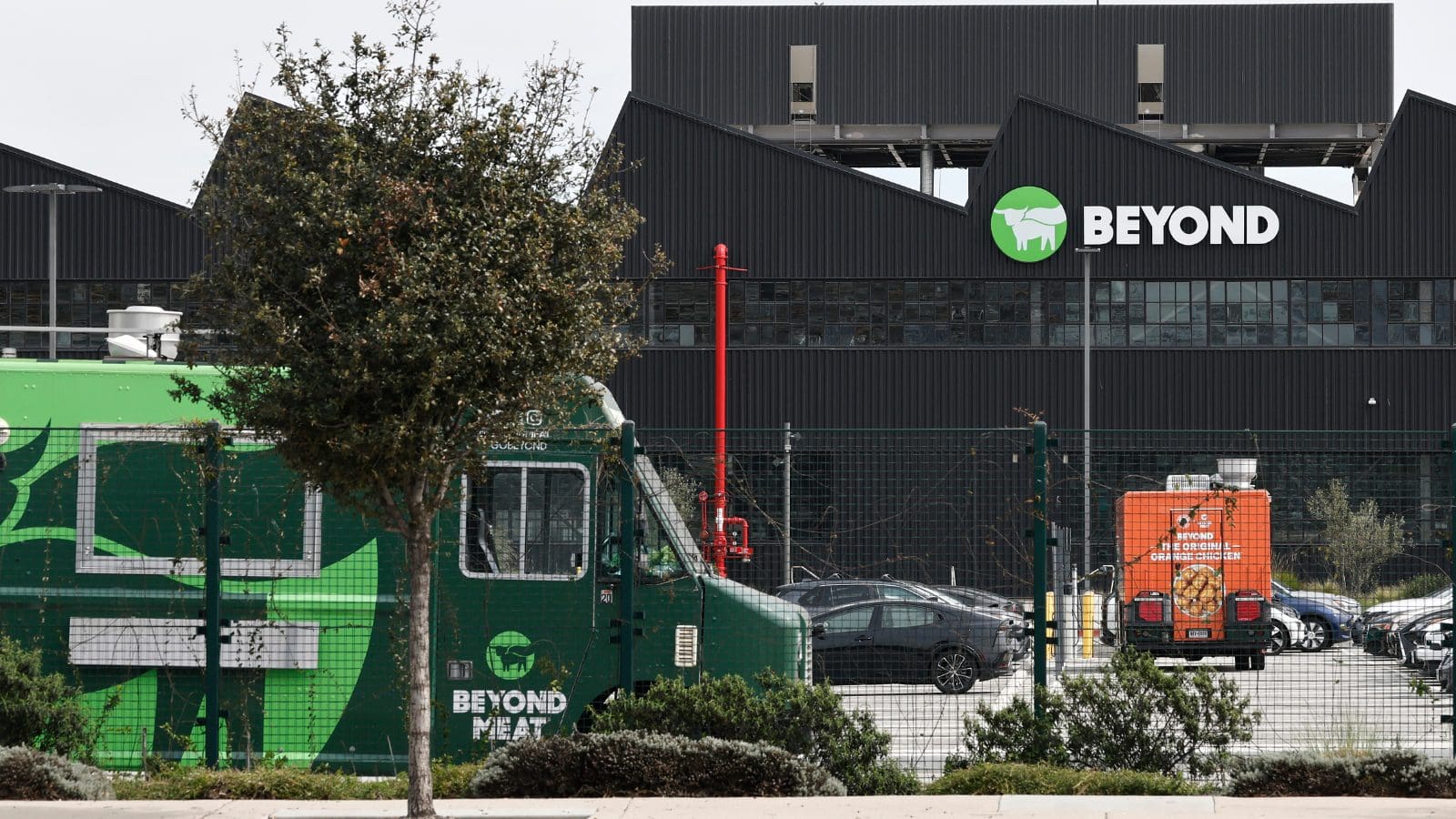
Ahead of Beyond Meat, Inc.’s delayed Q3 earnings announcement scheduled for Nov. 11, the company made headlines as its stock surged following a debt-exchange deal and short-lived “meme-stock” rally before tumbling again.
Similarly, competitor Meati, which attracted significant media attention when it was acquired for US $4 million after raising nearly US $450 million in funding earlier this year, has also regained the spotlight.
Despite these headlines, both companies appear to be resiliently designing their comeback strategies, with D2C emerging as an important part of their recovery plans.
Beyond launches “Test Kitchen” and D2C push
Beyond recently unveiled its “Test Kitchen” initiative, designed to pilot premium formats directly via D2C channels. The company currently offers several bundles, including its new ground-meat variations and steak filet, priced between $70 and $85. As the products are currently sold out, it is unclear whether shipping costs are included in these prices.
The Test Kitchen appears to signal a renewed emphasis on building a closer relationship with consumers, gathering direct feedback and testing product concepts before upscaling and broader retail rollout.
Inside Meati’s direct-to-consumer recovery strategy
Almost concurrently, Meati announced a formal D2C channel launch on their social media. The company is offering a bundle of 8-packs for $99 with free shipping, a roughly $10 price increase from two weeks ago.
This does not come at a surprise. The business was acquired by a vehicle owned by TV advertisement and infomercial specialist InvenTel (via entrepreneur Yasir Abdul) in a deal tied to its financial restructuring. Unconfirmed rumors suggest the brand may be repositioned as a “As Seen On TV”-style offering, and their D2C offering might be a first step for this.
Direct-to-consumer is promising but needs proof
The D2C model offers alt-protein companies several advantages: consumer data, closer customer relationships and accelerated feedback loops. It’s one reason brands like Juicy Marbles and Offbeast have long operated in this channel. Also, consumer willingness to pay for these bundles is an important testament for the industry.
However, the model is not without its challenges. Frozen fulfilment is cost intensive. Fulfilment and shipping costs for similar bundles range from $30 to $40 per package, especially when working an external fulfillment provider. Cost of customer acquisitions for digital ads for companies in the space run from $12 to more than $50 in the vegan-delivery box space.
Adding to the pressure: both Beyond and Meati have been plagued by weak gross margins in existing sales channels. Beyond has only recently regained gross-profit positivity in limited periods, while Meati earlier this year acknowledged it is still gross margin negative.
Next steps
With both plant-based meat pioneers entering the direct-to-consumer arena, Beyond Meat appears to hold the advantage. The company seems to treat D2C as a complementary channel while continuing to expand in retail. Last month, Beyond announced new distribution across 2,000 Walmart locations, underscoring that its turnaround is still anchored in mainstream grocery.
Meati, by contrast, appears to be relying almost entirely on direct-to-consumer sales for its recovery. While D2C has proven effective for other alt-protein brands, it remains to be seen whether Meati can depend on this channel alone to cover its operational costs and move toward profitability. Its success or failure may hinge on managing customer acquisition costs, a challenge that has tested even well-capitalized players in the frozen and refrigerated category.
Still, both companies’ renewed attention to the end consumer signals a healthy shift for the category overall – one that prioritizes stronger customer relationships, faster feedback loops and more responsive innovation in a market that increasingly rewards authenticity and engagement.
About the Guest Author
Insa M. Mohr is an expert in biomanufacturing and strategy design and implementation. As a former strategy consultant in BCG’s healthcare practice and Associate Director of Strategy & Innovation at Merck KGaA, one of the areas she dealt with texturizing solutions for alternative proteins. She is also the founder of Offbeast, a US-based startup pioneering the manufacturing of plant-based whole cuts.