The global food system significantly contributes to environmental degradation. Livestock is the primary driver of deforestation – surpassing even palm oil –and is responsible for 57% of water pollution while providing only 37% of the world’s protein1,2,3. Consequently, some studies regard meat consumption as one of the largest threats to fauna and flora globally4. If current trends continue, it is predicted that by 2030, meat consumption will be responsible for 37% of the greenhouse gas emissions (GHG) emissions permissible under the 2 °C target and 49% of those allowable under the 1.5 °C target5. On a personal level, the standard diet in Western, developed countries is high in meat and dairy and therefore accounts for large volumes of GHG emissions each day (e.g., 8.8 kg CO2e in the UK)6,7. Animal agriculture also contributes to a range of other environmental and health issues, including antimicrobial resistance, pandemic risk, cancer and cardiovascular diseases, and water and air pollution8,9,10. For these reasons, scientific literature underscores the need for dietary changes to mitigate environmental impacts11. However, achieving long-term behavioural change in dietary habits is challenging12, leading to a need for meat substitutes to facilitate this transition.
Industrialised insect farming is one emerging technology that could reduce environmental impacts. Compared to conventional livestock, insects are most promising regarding GHGs, land use and energy use, although they would likely lead to increased water consumption13,14,15. Human health risks would also be lower compared to traditional livestock.
While the opportunities outlined above look promising, it is important to keep in mind that the lower environmental impact of insects compared to meat is not extraordinary—most foods, including protein-rich ones, are less resource-intensive than meat. For instance, most plant-based options produce only a fraction of the GHG emissions of equivalent meat-based products1,16,17. Therefore, finding a product with a lower environmental impact than meat is not a difficult task since most foods already surpass this benchmark. The real challenge lies in creating alternatives that are compelling enough for consumers to prefer over meat.
Social and consumer preferences are of the utmost importance for the widespread market inclusion of these products18. Focusing solely on the environmental benefits of insects compared to meat, or their nutritional value, does not provide the entire picture. Culture and habits make changing dietary practices difficult, even with familiar products19. Moreover, while the literature often highlights strategies to promote the adoption of insect-based foods, it frequently overlooks the considerable challenges of achieving the long-term disadoption of meat20.
A comprehensive review of 91 articles by Onwezen et al.21 revealed that insect-based proteins ranked lowest in acceptance among various meat substitutes, falling behind cultured meat, with plant-based options rating the highest acceptance, up to 91%22. This finding aligns with other studies22,23,24,25. In another review, insects were also found to be the least promising in terms of environmental impact, scalability, animal welfare, and consumer acceptance (compared to plant-based meat substitutes, single-cell proteins and cultivated meat)26. Furthermore, insects are also projected to achieve price parity later than these alternative proteins27. This review assesses the prerequisites for insect-based foods to compete with meat and evaluates their likelihood of meeting these requirements. While conducting a literature review on the potential contribution of insect farming to sustainability28,29,30, between August 2023 and March 2024, we searched for terms such as “insect farming,” “consumer acceptance/acceptability,” “black soldier fly,” “mealworm,” and “cricket”, using Google Scholar, Scopus, OpenAlex and ScienceDirect. Priority was given to reviews offering broad overviews of the topic, supplemented by non-scientific sources, such as grey literature, where data was unavailable elsewhere, including information on investment trends. We first explore the key drivers of meat consumption. Then, we examine the current state of consumer acceptance for insect-based products, highlighting barriers and assessing whether proposed strategies to increase acceptance are likely to succeed. Finally, we discuss structural and economic barriers such as the limited investment in the insect-based food market.
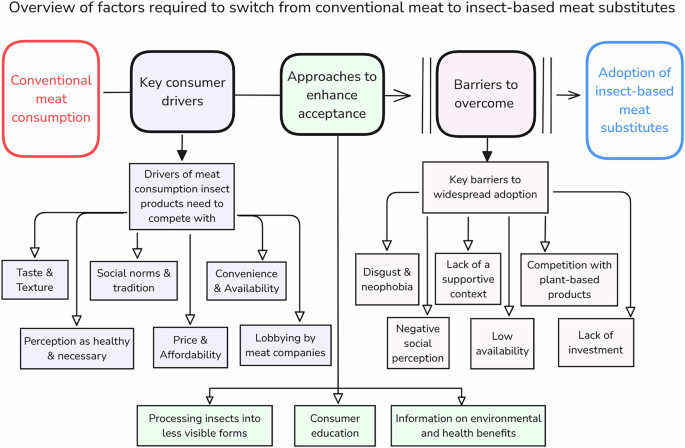
Figure 1 summarises the key drivers and barriers influencing the acceptance of insect-based meat substitutes, providing a conceptual framework for the subsequent discussion.
Drivers of meat consumption
To assess the potential of insects as a meat alternative, it is crucial to understand why people consume meat in the first place. Key reasons for meat consumption include taste appeal and texture, as an inferior sensory quality can be a barrier to widespread adoption; perception of meat as a necessary part of a healthy diet; social norms and tradition; price and affordability; and availability and convenience31,32,33. Therefore, for insects to be a viable alternative, not only do they need to be environmentally more sustainable and nutritious, but they also need to be competitive in these areas. The cultural significance of meat, entwined with aspects like religion, gender, community, and social identity, makes this more than just a dietary choice34. De Boer and Aiking35 emphasise the cultural implications of reducing meat consumption, which can sometimes conflict with aspects of personal identity related to masculinity, social class, or political orientation. Consequently, individuals with a strong attachment to meat often resist changing their dietary habits.
Moreover, the meat industry’s substantial economic presence and political influence can shape public perception and policies. According to Carrington36, “the money spent on lobbying the US government by meat producers was 190 times more than for [plant-based meat or cultivated meat groups]. […] Livestock farmers in the EU received 1200 times more public funding.” During the formulation of the U.S. Dietary Guidelines, lobbying from the meat industry was intensive, with several organisations claiming that this influenced final recommendations33. Leaked documents, reported by the press, even reveal that the meat industry successfully lobbied the Intergovernmental Panel on Climate Change (IPCC) to remove mentions of meat’s environmental impact from the Panel’s most recent report37. If insect-based meat substitutes gain traction, they may encounter significant opposition from the meat industry38. This is evidenced by campaigns against plant-based foods, including both negative advertising and efforts to regulate the labelling of plant-based products such as “burger”, “steak”, or, since a 2013 law in the EU, “milk” and “cheese”37,39,40,41.
Key barriers to consumer acceptance
Replacing meat with alternatives such as insect-based foods requires addressing deeply rooted social, cultural, and ideological beliefs about food and society. Societal norms can evolve with the support of civil society, health organisations, and governments, yet this is a lengthy and complex process42. This complexity underscores the importance of understanding consumer attitudes toward insect-based foods and the challenges they pose.
Overview of consumer’s willingness to use insect products
The successful establishment of the insect industry in Western societies depends on the willingness of consumers to use these products43,44. However, many studies in different contexts (surveys, tastings, interviews) show a very low willingness to try insect-based products, generally below 30%, although higher percentages sometimes emerge in the literature45. In the UK, the inclination to consume insects is similarly low, with only about 24–26% of consumers showing a willingness to try46,47. Notably, among those who did not want to try any suggested substitutes, the majority (67%) stated that nothing could persuade them to try edible insects47.
One of the few studies on UK consumer attitudes towards insect-based foods examined consumer willingness to pay for insect-based versus pork-based sausages48. The study concluded that the potential for insect-based foods to revolutionise modern diets is limited by the “pervasive negative consumer perceptions” of these products, evidenced by the “significant price penalties” consumers placed on insect sausages. While certain consumer groups, particularly eco-conscious consumers with low food neophobia, might be increasingly open to incorporating insect products into their diets, they still imposed significant price penalties on insect sausages, despite being informed about their health and environmental benefits.
The proportion of consumers willing to incorporate insects as a substantial, regular part of their diet is even lower (especially at the expense of a highly-valued and culturally significant product such as meat). While willingness to try requires initial curiosity and an interest in benefits, increasing willingness to buy regularly also requires the product to taste good and be appropriate in the cultural context19.
Psychological and social barriers to consumer acceptance
The main barrier to market development in Western countries is the “psychological rejection experienced by consumers”, predominantly due to feelings of disgust45,46,48,49,50,51,52,53,54. Disgust, a response of revulsion or strong disapproval to something perceived as unpleasant or offensive55, serves as an emotional defence mechanism to avoid ingesting potentially harmful substances through the mouth56.
While entomophagy (the practice of eating insects) is widespread in many non-Western countries, with an estimated two billion people globally practising it57, perceptions in Europe and North America differ significantly. In these regions, insect consumption is often associated with poverty and a “primitive” lifestyle58,59,60. The common presence of many insect species in and around waste further reinforces insects’ association with disease, dirt, and decay61. Overcoming this disgust reaction presents a significant challenge, as the aversion to insects is a “deeply embedded core emotion in Western societies and shaped by culture, social norms, and previous experiences”52,62.
Perceived health risks also play a role45,63,64. These concerns encompass potential allergens and biological and chemical hazards60. Even with regulatory approvals, such as the European Union’s authorisation to include insects in various food products, substantial efforts are required to assure consumers of their safety.
Furthermore, the prospect of feeding insects with food scraps may add to the difficulty, as it is unclear whether Western populations would be receptive to consuming waste-fed insects65. By comparison, the acceptability of food waste as feed for conventional livestock has already encountered significant resistance in China66. Therefore, ensuring the use of hazard-free insect feed (substrate) in insect agriculture is crucial60.
Another major barrier is food neophobia, the avoidance of unfamiliar foods67,68,69. Individuals with high levels of food neophobia are less likely to even consider trying and purchasing insects for consumption, irrespective of their origin48,70.
Social norms, or the influence of other people’s opinions, also contribute to consumers’ negative perceptions of entomophagy45,71,72,73. One notable obstacle to insect consumption is its “incompatibility with local food culture”74. Generally, “the stronger the gastronomic culture within the society, the greater the rejection, and vice versa”70,75. Even in France, known for its acceptance of invertebrates like snails, a study found that people were slightly unwilling to consume insect-based foods76.
These trends are deeply rooted in culturally determined food habits, making them challenging to change. In regions where entomophagy is commonplace, insects are considered valuable protein sources. In contrast, Western cultures often associate eating insects, especially whole, with negative connotations. This perception is reinforced by Western media, as seen in reality television shows— in Fear Factor and I’m A Celebrity, Get Me Out Of Here!, eating raw insects is portrayed as a test of bravery77.
Approaches to enhance consumer acceptance
The literature has explored various interventions to boost consumer acceptability of insect-based foods78. Research has identified characteristics associated with greater acceptance of insect products, though the results are sometimes conflicting. Men generally show more openness towards consuming insects51,79, but findings regarding the influence of age and education are inconclusive, with income appearing to have little impact46. Factors with a positive influence include curiosity about new foods and frequent travel45.
Processing insects into less visible forms
To mitigate unfamiliarity and enhance acceptance, a common strategy involves processing insects into forms where they are less recognisable, such as grinding them into powder31,80 or incorporating them into familiar products50,81.
However, it is important to note that the aforementioned low willingness to consume insects pertains even to these more attractive, processed forms. Acceptance remains low even in insect-based foods consumers were the most willing to try, such as snacks (37%), main dishes (26%), and desserts (23%)79. Acceptance drops further for meals like insect-based salads (7%) or soups (6%). Unprocessed insect dishes scored lowest (1%), as certain physical attributes of insects are particularly off-putting, such as long, spiny legs or a slimy body texture46.
Since meat-like insect products receive even less consumer acceptance than snacks, substituting traditional meat with insect-based alternatives appears even more challenging than anticipated. This helps explain why approximately 90% of the insect-based foods market consists of products that do not directly compete with meat, such as snacks, pasta, or bars82. Since insects generally have a higher environmental impact than plant-based products17, incorporating insects into these items is likely detrimental from a sustainability perspective83. Although brands promote these products as sustainable, their arguments often rely on comparisons with animal products, even in the case of snack bars84.
Informing about environmental and health benefits
While public authorities have often highlighted the environmental benefits of insect-based protein to promote consumption, the impact of this approach on consumer attitudes remains uncertain45. Some studies suggest that environmental concern can increase willingness to try insect-based products, yet others do not find it a significant factor in adopting entomophagy48. Even if environmental concerns enhance acceptability, their effect is relatively minor compared to factors like disgust and food neophobia85.
What emerges from the literature is that sustainability per se probably will not persuade consumers to incorporate insects into their diet45. In everyday consumer decisions, immediate personal benefits often outweigh long-term benefits for the community, and affect is more important than information85. Weinrich86 suggests that appearance and taste are the most important factors in eating meat substitutes regularly, while health or environmental factors remain distant and only persuade consumers to try the product85. Berger et al. argue that focusing on such benefits when marketing insects may even backfire87.
Consumer education
Prior experience with eating insects has been shown to increase future willingness to consume them46,48,49,51, a finding corroborated by multiple studies70. A promising approach involves providing consumers with a positive initial experience with insect-based foods. Suggested strategies for generating a favourable first impression include educating consumers, such as through tastings in bars or museum exhibitions60,88. However, even these positive sensory experiences may prove insufficient to pass the significant hurdle of neophobia89.
Consumer education may need to be very intensive to reach higher levels of consumer acceptance90. This approach must be executed carefully, as negative taste experiences can diminish acceptance of insect-based products46. The time and resources required may be prohibitive—former insect company co-founder Michael Badeski warns that “tastes change, but it can take a generation. Spending venture equity dollars on an uphill battle to educate customers is not a good use of capital”91.
While increasing opportunities for consumers to try insect-based products could enhance familiarity and positively influence acceptance45,92, doing so requires expanding the reach of the market. This is linked to another structural challenge: the limited availability of insect-based products.
Structural and economic barriers
Consumer acceptance is not the only challenge that insect-based meat substitutes must face. Replacing meat, or any kind of food, goes far beyond just proposing an additional product to the market that consumers would accept to try once. Even when willing consumers are highly interested, they hesitate to consume edible insects regularly due to practical and economic factors related to availability, knowledge, a supportive context, and pricing19.
Lack of a supportive social context
Proposed solutions in the literature about insect-based foods often underestimate the complexity of introducing new food types into society. Abstract ideas such as the ‘willingness to eat’ tend to overlook the geographic and sociocultural contexts that influence the adoption of new foods. House93 challenges the assumption that widespread acceptance of insects, or other unconventional foods, is primarily a matter of convincing or educating consumers. Insects have been likened to “the new sushi”94,95, suggesting a similar pathway to acceptance, as raw fish went from a scarcely accepted food in the 1950s to a widely accepted one in the US. Yet, the introduction of sushi in the West was not about selling a new food in a new location out of context. Initially offered in sushi bars by Japanese chefs, sushi was often experienced during business meetings, where skilled chefs showcased age-old practices and used well-known imported ingredients. Japanese immigrants represented a stable consumer base for sushi bars, and they introduced their Western counterparts to it. This approach allowed Western consumers to be gradually recruited to new food consumption practices, and involved more than just a new ingredient—it was a cultural experience93.
In contrast, insects are often introduced in less contextualised settings, such as convenience stores or online platforms. The insect species produced by industrialised Western farms are rarely the same species consumed by populations engaging in entomophagy93,96, and do not draw on the practices of established cultures and cuisine. For example, mealworms—one of the most commonly farmed species in Europe—are perceived as disgusting by some Thai practitioners of entomophagy because they are often associated with rotting matter96.
Lack of availability and knowledge
The small scale of the edible insect market has been identified as a structural barrier45. The limited availability of insect-based products in restaurants and supermarkets and the scarcity of opportunities to try these foods are cited as a critical factor in not consuming insects97,98,99,100. Currently, the primary avenue for purchasing insects is through online shops, which attract only niche consumers, and product variety is limited by extended transportation times.
Moreover, even among those open to purchasing insects, there is a lack of knowledge regarding how to incorporate them into recipes. House93 reports the experiences of individuals facing this challenge, including those open to entomophagy and eager to learn new recipes. For instance, one woman tried to prepare a mealworm curry based on an online recipe. However, her cooking attempt was unsuccessful due to the insects’ small size, and she eventually resorted to consuming them as snacks while watching television.
Competition with established products
Additionally, even in supermarkets, insects must compete with well-established alternatives101. Positioned as just another option among many, insects face competition based on criteria such as price, taste, and availability, where they may not have distinct advantages for consumers93, and are less appealing than the familiar original product102.
For example, while someone might be willing to try insect-based tortilla chips, these chips are in direct competition with popular, well-marketed brands101. New products generally need to offer a distinct advantage over existing ones, yet it is unclear what consumers gain by choosing insect-based chips, especially given the lack of a clear environmental benefit, as discussed earlier. The approach of processing insects into familiar products in an “invisible” way strips away the uniqueness and distinctiveness of the ingredient93. Although insects are marketed as protein-rich, this is not the main reason people consume chips or snacks.
Competing with established meat companies relies significantly on taste and texture, yet research on that topic is limited, with inconsistent results. A study involving a consumer panel in Germany suggested that the insect-based burger was better rated than alternatives. However, this conclusion is based on a small sample size (70 participants, with nine refusing to taste the insect burger)18. On the other hand, other studies indicated that, similarly to plant-based alternatives, successfully simulating a meat-like flavour, colour, and structure remains challenging for insect-based products27,103. Moreover, a study in the UK suggested that although cricket-based products did not taste bad, a pleasant taste and familiarity were not enough to overcome disgust92.
Comparison with plant-based alternatives
Additionally, insect-based meat substitutes tend to target the same demographic as other alternative proteins and might compete with this market. For instance, plant-based meat substitutes are gaining wider acceptance, as evidenced by their growing research focus and market share104. Plant proteins are projected to be the dominant alternative protein source in the next decade105. Economically, they are advantageous as they circumvent the feed-to-food conversion loss characteristic of animal protein sources. The World Health Organization also judges that appropriately planned plant-based or predominantly plant-based diets are healthier and more environmentally friendly than conventional diets106.
Many plant-based products are already available in the market in various forms, such as whole, powdered, or processed, in restaurants and supermarkets. Meat substitutes like Impossible Nuggets or Beyond Burgers have penetrated the mainstream. They feature in large food chains such as Burger King, a milestone not yet achieved by insect-based products. These products cater to environmentally conscious consumers interested in new protein sources105.
However, compared to plant-based products, insects do not appear to offer any significant advantages. Consequently, there is a risk that they could divert attention from more sustainable alternatives107. Resources allocated to insect farming might have a greater positive environmental impact if directed toward promoting plant-based foods instead83.
Lack of investment
Investors seem aware of the abovementioned issues, and investments in insects as food products are surprisingly small. A report by Dutch industry analyst RaboResearch notes that the current potential of insect-based foods for human consumption is “limited” and their market share “negligible”108.
In contrast, the vast majority of Western industrial insect production aims to produce animal food, such as livestock feed and pet food70,79. In 2022, 95% of the industrial insect industry’s funding, amounting to 1.2 billion USD, was directed to the feed market. This means that only 5% of funding is for insects as human food. Even within this 5%, less than 10% is for meat substitutes specifically, meaning they represent less than 1% of the overall insect market82.
Insects are routinely labelled as “alternative proteins” and included in debates on the topic of meat replacements21,38. However, insect farms in Western countries are more often used as a source of input for conventional proteins, such as livestock feed.
Limitations and future directions
There are significant limitations in the literature. Consumer acceptance studies show substantial variability based on factors such as country, product type, and methodology. Many studies on willingness to pay rely on online hypothetical scenarios44, with a scarcity of studies examining consumers’ actual willingness to pay for these products in real-world settings70. While much research has focused on willingness to try or buy insect-based foods, structural and economic challenges—key to understanding market dynamics—are less frequently addressed, limiting the scope and accuracy of this review. Additionally, few studies examine the true drivers of meat consumption and how insects might compete in this regard.
Future research should address these gaps by focusing on key areas: examining investment trends in the insect-based foods market, conducting more in-depth studies on the sensory appeal of insects, and exploring the acceptability of insect-based meat substitutes specifically, not just insect-based foods, as it is the most promising from an environmental standpoint. Identifying consumer demographics or niches where insect-based foods may outperform plant-based alternatives could be valuable, if they exist. Further studies could investigate willingness to pay in real-life contexts, systemically compare insect-based products with alternative proteins, and assess the costs and feasibility of creating a social context conducive to promoting insect consumption.