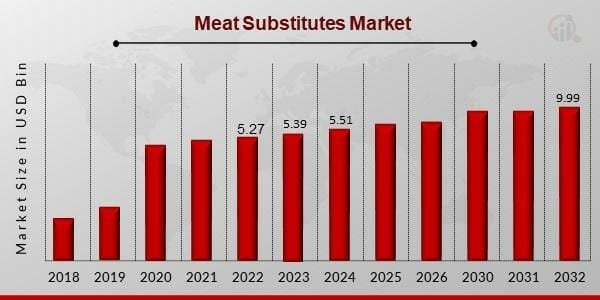
In recent years, the meat substitutes market has moved beyond niche diets and specialty stores to become a major player in the global food industry. Spurred by health, environmental, and ethical concerns, plant-based proteins and alternative meat products are reshaping how consumers think about what’s on their plate. According to a recent report by , this market, valued at USD 5.39 billion in 2023, is projected to nearly double to USD 9.99 billion by 2032, growing at a compound annual growth rate CAGR of 7.72% between 2024 and 2032.
Obtain a Sample File Containing Insights from Camping Beds and Mats Market Research Report @ https://www.marketresearchfuture.com/sample_request/1969
Key Drivers of Demand
Several forces are fueling this growth:
Health Consciousness
Consumers are increasingly worried about the downsides of traditional meat consumption-cholesterol, saturated fats, and animal‐borne diseases. Meat substitutes that are cholesterol‐free and rich in plant proteins are viewed as healthier choices.
Environmental and Ethical Concerns
Climate change, sustainability, and animal welfare have become central values for many consumers, especially Millennials and Gen Z. These cohorts are driving demand for food products that minimize environmental impact and avoid animal suffering.
Changing Lifestyles and Diets
Flexitarian, vegetarian, and vegan diets are no longer fringe. Even non‐vegetarians are reducing meat intake for reasons like weight management, sustainability, or simply curiosity and variety.
Product Innovation
Advances in texture, taste, smell, and form have made alternatives more appealing. From tofu and tempeh to mycoprotein and wheat‐based seitan, there is now a variety of products that come closer than ever to mimicking traditional meat.
Market Segments: What’s Leading
The market consists of multiple segments:
By Type: Tofu & tofu products dominate, accounting for about 65-67% of revenue in 2021. Other types include tempeh, seitan, and “others” which might include newer or hybrid forms.
By Source: Soy is the leader-both for its historical prevalence and its use in tofu, tempeh, etc. Wheat and mycoprotein are also important sources.
By Distribution Channel: Store‐based sales supermarkets, specialty stores are dominating and are expected to grow fastest compared to non‐store based online, direct to consumer. Consumers tend to prefer store‐based channels for checking freshness and assured quality.
By Region:
North America is the largest market, with revenues in 2021 of about USD 2.22 billion. It also has strong growth expectations.
Europe follows, with countries such as Germany, the UK, and France as major consumers. The UK is among the fastest growing in Europe.
Asia-Pacific is expected to have the fastest CAGR through 2022-2030, led by rising incomes, changing diets, and growing awareness. China holds a large share; India is among the fastest‐growing in this region.
“Buy Now” – Take immediate action to purchase the full report and access all the valuable information it contains: https://www.marketresearchfuture.com/checkout?currency=one_user-USD&report_id=1969
Trends & Strategic Moves
As the market expands, several trends and strategies are becoming clear:
R&D & New Product Launches: Companies are investing in products that better mimic meat in texture and taste. Also, novel ingredients mycoprotein, hybrid blends, etc. are coming to the fore.
Partnerships & Collaborations: To boost reach and improve product offerings, players are forming alliances. For example, producers are collaborating with ingredient suppliers or with food service/restaurant chains.
Localizing Production: To cut costs, improve logistics, and maintain freshness, makers are setting up local supply chains, especially in fast-growing regions like Asia-Pacific.
Challenges & Limitations
Even with strong growth, the market faces some hurdles:
Taste & Texture Gaps: Despite improvements, many consumers still find plant-based alternatives lacking compared to real meat in mouthfeel, flavor, and “experience.”
Cost Issues: Some meat substitutes are still more expensive than conventional meat, particularly in markets where meat is heavily subsidized or cheap.
Regulatory & Labeling Concerns: Different countries have different rules on what can be called “meat substitute,” “plant-based meat,” etc. This can affect marketing and consumer trust.
Cultural & Dietary Barriers: In some regions, meat is deeply embedded in cultural or religious food practices; shifting such habits takes time.
To Access The Complete Market Research Report and Detailed Forecast Data, Please Visit: https://www.marketresearchfuture.com/reports/meat-substitutes-market-1969
What the Future Holds: Innovations & Opportunities
Looking forward to 2030 and beyond, several innovation frontiers stand out:
Hybrid Products: Blends of plant-based proteins with cultured meat or lab-grown components might bridge taste/texture gaps while keeping ethical/environmental benefits.
Alternative Protein Sources: Beyond soy, wheat, and mycoprotein, newer sources like algae, insect proteins, or novel legumes may gain traction.
Functional Additions: Products fortified with vitamins, minerals, or extra nutrients e.g., omega-3, iron to address health concerns of consumers who reduce meat intake.
Clean-Label & Minimal Processing: Demand for “clean-label” fewer additives, natural ingredients products will push manufacturers to simplify ingredient lists while maintaining texture and taste.
Improved Sustainability Across the Value Chain: From sourcing and farming to packaging and distribution, sustainability will remain a watchword-not just in marketing but in operational practice.
Customization & Local Taste Profiles: As the Asia-Pacific region grows, there will be more demand for alternatives that suit local cuisines, flavors, and culinary uses e.g. spice blends, texture appropriate to local dishes.
The meat substitutes market is poised at an exciting juncture. Backed by a strong growth rate 7.72% CAGR, nearly doubling in value within a decade, driven by health, environmental, and ethical imperatives, it’s not just a fad-it’s becoming mainstream. But success will depend on bridging sensory gaps, making products affordable and accessible, and innovating both in product development and sustainability. For companies entering the space, those who invest in R&D, local relevance, and partnering across supply chains are especially well-positioned.
Discover more research Reports on Food, Beverages & Nutrition, by Market Research Report
China Meat Substitutes Market: https://www.marketresearchfuture.com/reports/china-meat-substitutes-market-57967
India Meat Substitutes Market: https://www.marketresearchfuture.com/reports/india-meat-substitutes-market-57966
Japan Meat Substitutes Market: https://www.marketresearchfuture.com/reports/japan-meat-substitutes-market-57965
binders scaffolders meat substitutes market: https://www.marketresearchfuture.com/reports/binders-scaffolders-meat-substitutes-market-26954
Frozen Meat Market: https://www.marketresearchfuture.com/reports/frozen-meat-market-2693
Contact us:
part of Wantstats Research and Media Private Limited,
99 Hudson Street,5Th Floor, New York, New York 10013, United States of America
Contact Number:
+1 855 661-4441 US
+44 1720 412 167 UK
+91 2269738890 APAC
Email: [email protected]
About :
At MRFR, we enable our customers to unravel the complexity of various industries through our Cooked Research Report CRR, Half-Cooked Research Reports HCRR, Raw Research Reports 3R, Continuous-Feed Research CFR, and Market Research & Consulting Services.
MRFR team have supreme objective to provide the optimum quality market research and intelligence services to our clients. Our market research studies by products, services, technologies, applications, end users, and market players for global, regional, and country level market segments, enable our clients to see more, know more, and do more, which help to answer all their most important questions.
This release was published on openPR.