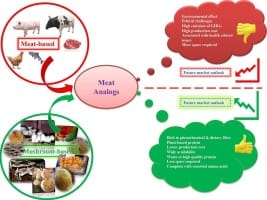
The growing global population, projected to reach 9.7 billion by 2050, presents significant challenges for food production and increased demand by one-third compared to 2015 (FAO, 2018). This significant population growth is projected to lead to a 14 % increase in global meat consumption by 2030, reaching over 377 million tons per year (OECD/FAO, 2022). The livestock sector, however, has significant environmental impacts, accounting for 20 % of global non-CO2 emissions (FAO, 2020). The food system continues to face significant challenges, including rising GHGs (Greenhouse Gases) emissions, natural ecosystem loss, and declining biodiversity, while also worsening challenges such as malnutrition, which affects nearly one billion people, and obesity, impacting two billion globally (IPCC, 2019). Replacing animal proteins entirely with plant-based analogues is estimated to decrease land use by 76 %, GHGs emissions by 49 %, eutrophication potential by 50 %, and water usage by 19 % in the United States (J. Zhu et al., 2024). However, consumption of red meat also causes cardiovascular disease (Fang et al., 2015; Hu et al., 2024; Wang et al., 2024), obesity (Kim et al., 2022), type 2 diabetes (Bao, Rong, Rong, & Liu, 2012; Li et al., 2024), lung cancer (Fonseca-Nunes, Jakszyn, & Agudo, 2014; Tasevska et al., 2009), coronary heart disease (Al-Shaar et al., 2020; Micha, Wallace, & Mozaffarian, 2010), non-alcoholic fatty liver disease (Hashemian et al., 2021; Ivancovsky-Wajcman et al., 2022; Kim et al., 2022; Rahimi-Sakak, Maroofi, Emamat, & Hekmatdoost, 2022; Zhou et al., 2024a), and hypertension (Allen, Bhatia, Wood, Momin, & Allison, 2022). Recent studies suggest that a global shift toward meat analogues is essential to address the environmental and health concerns linked to meat consumption (Henchion, Moloney, Hyland, Zimmermann, & McCarthy, 2021; Marinova & Bogueva, 2019). However, exclusively plant-based diets face challenges related to nutritional quality, textural properties, and consumer acceptance (Giacalone, Clausen, & Jaeger, 2022; Sha & Xiong, 2020; Tahseen et al., 2024; Xie, Cai, Zhou, & Li, 2024).
Mushrooms are known for their culinary attributes and are rich in nutritional value, including vitamins, minerals, and low calories, with high-quality protein comparable to muscle protein in terms of nutritive value (Khatun, 2012), and have been consumed by humans since ancient times (Raut & Adhikari, 2021). Romans called it “food of God” and Chinese as “elixir of life” (Bashir, Vaida, & Dar, 2014). The primary nutritional attribute of mushroom dry matter is carbohydrate (50 to 65 %) and consists of both digestible (such as trehalose, glycogen, mannitol, and glucose) and non-digestible carbohydrates (like chitin, mannans, and β-glucan), which is rich in dietary fibre. Mushrooms provide all essential amino acids (EAAs) and have a significantly higher proportion of polyunsaturated fatty acids (PUFAs) compared to saturated fatty acids (SFA). They are also the only vegetative source of vitamin D and rich in vitamin B complex and various essential minerals that support human physiological functions (Rathore, Prasad, & Sharma, 2017; Samsudin & Abdullah, 2019), and low in fat and sodium, as well as low in energy content (Ahmed, Abdullah, & Nuruddin, 2016; Synytsya, Míčková, Jablonský, Sluková, & Čopíková, 2008). Vitamin D deficiency is associated with numerous chronic and infectious diseases (Siddiqee, Bhattacharjee, Siddiqi, & MeshbahurRahman, 2021), and approximately 50 % of the global population experiences vitamin D deficiency (Holick, 2007; Nair & Maseeh, 2012). In India, an estimated 67–73 % of the population is deficient in vitamin D, with the prevalence being higher among females than males (Siddiqee et al., 2021). Similarly, vitamin D deficiency of 20–90 % was reported in regions such as Europe, the USA, and the Middle East (Amrein et al., 2020; Lips et al., 2019).
Edible mushrooms have long been recognised for their therapeutic potential, attributed to a range of medicinal properties like anti-tumour, antioxidant, immunomodulatory, anti-microbial, anti-inflammatory, cardiovascular-protective, cholesterol-lowering, anti-obesity, anti-diabetic, radical-scavenging, anti-fungal, anti-cancer, and various other health-promoting benefits (Fig. 1) (Wasser & Weis, 1999; Yadav & Negi, 2021). Health benefits of some mushroom species bioactive agents were tabulated in Table 1. The significance of incorporating mushrooms into the diet has become more than ever during the SARS-CoV-2 pandemic. Regular consumption of natural products like Inonotus obliquus, Lentinula edodes, and Grifola frondosa, known for their potent antiviral and anti-inflammatory properties, can help mitigate the effects of SARS-CoV-2 and support the body’s defence against the virus (Shahzad, Anderson, & Najafzadeh, 2020).
Mushroom or fungal protein is considered superior to bacterial and vegetable proteins for several reasons; unlike the strong beany flavour of soy protein, fungal protein offers appealing, mild, umami-rich mushroom flavour; texture is naturally soft and smooth but can be easily modified through cooking to replicate the juicy, firm texture of meat; mushroom mycoproteins are initially bland and colourless; they can be enhanced to resemble a variety of meats, such as chicken or ham, with added flavour and colour; and additionally, mushroom provides significant health benefits, including anti-tumour properties, making fungal protein a nutritionally superior and versatile alternative to plant or animal meat (Rousta et al., 2021; Singh & Sit, 2022).
Mushroom proteins, an alternative to animal-based protein, offer complete nutritional attributes like EAAs profile, vitamins (B complex and D), minerals, and its therapeutic properties, which can fulfill RDA (Recommended Dietary Allowance) requirements and an ideal idea for the development of potential meat analogues. Therefore, this review explores the potential of mushrooms as an alternative source for meat analogues.