Livestock farming is a major climate change culprit. Meat and dairy account for about 15 per cent of greenhouse gas emissions, mainly in the form of methane and nitrous oxide. Producing plant-based foods generates roughly half the emissions of meat-based products, according to recent studies. Shifting diets, even gradually, could free up farmland, cut methane, and improve public health.
But old habits die hard. For many people, a charred steak or succulent sausage is not easily swapped for tofu or lentils. That tension is why governments and companies are searching for a middle way: meat substitutes and hybrids that promise familiar flavour but with a lighter environmental footprint.
From beef burgers blended with beans to fermented dairy products, a growing range of substitutes is available. But the challenge is whether they can scale quickly enough, stay affordable, and persuade people to change what ends up on their plates.
How does it work?
Meat substitutes use different strategies to recreate the flavour and texture of animal products while lowering emissions.
FT Guides: climate tech
This is the latest part of the FT’s guide to the technologies that will help the planet reach net zero. Each article covers the same questions. Other articles cover rapid-charging EVs and rock weathering
One of the most common is the use of plant proteins such as soy, peas or wheat. These are ground into flour, concentrated, and processed through extrusion in a technique that uses heat and pressure to form fibrous textures resembling animal muscle. The resulting material can be flavoured and shaped into products ranging from “chicken” nuggets to faux tuna.
Another approach relies on fermentation. Fungi can be cultivated to produce dense, protein-rich filaments that naturally mimic meat’s chewiness. Precision fermentation goes further: microbes are programmed to generate specific animal proteins such as casein or whey, which can be used to make dairy substitutes almost indistinguishable from the real thing.
Finally, some companies take a hybrid route. Dutch retailer Albert Heijn, has launched sausages and cold cuts that blend beef or pork with beans, beet fibre or celeriac, aiming to see if shoppers will accept gradual changes. Because plant ingredients require far less land, water and fertiliser than livestock, replacing even part of the meat reduces the product’s overall carbon footprint while also lowering saturated fat.

What are the pros and cons?
Meat substitutes could make a significant dent in emissions. Substitutes can also reduce saturated fat in diets, with potential public health benefits. For governments, they offer a politically easier route to cutting agricultural emissions than telling people to eat less meat.
The biggest advantage, however, is familiarity. By offering burger or sausage lookalikes, companies hope to lower the psychological barrier to change. “We are not producing plant bait for the vegans and the vegetarians; they have already found their solutions,” says Ulrich Kern-Hansen, founder and chief executive of Organic Plant Protein, a Danish company that produces meat-like products. “People in the western countries that have grown up in a meat-based culture, they like meat. They really do like meat. They like the taste and like the feeling of when they bite it . . . that’s what we’re aiming for.”
But there are drawbacks too. Many plant-based analogues are highly processed. They often use additives, flavourings and stabilisers to achieve meat-like textures, so the end-product may not be particularly healthy. Some can be more expensive than the real thing, particularly if made with precision fermentation, where costs remain high. Critics also question their nutritional value: substitutes can match protein levels but sometimes fall short on micronutrients such as iron and vitamin B12.
Taste remains a sticking point, too. While some products come remarkably close to the “real thing”, others fall short. As one Danish alt-protein entrepreneur puts it: “Technology alone isn’t enough; if it doesn’t taste good, people won’t buy it twice.”
Will it save the planet?
Substituting beans or fungi for beef can dramatically cut emissions: for every 1kg of beef, about 60kg of CO₂ equivalent is produced, while legumes generate less than 1kg.
But global demand for animal protein is rising as incomes grow, especially in Asia and Africa, and substitutes are unlikely to replace meat fast enough to cancel out that trend. Hybrids, which reduce rather than eliminate meat content, deliver more modest climate benefits.
Cost and uptake are also critical. Precision-fermented proteins and fungi-based meats remain expensive to produce, while many consumers in lower- and middle-income countries may struggle to access them. Even in Europe and North America, sales of substitutes are tiny when compared to total meat sales.
Advocates see potential for meaningful reductions if governments incentivise production and if substitutes move from niche products into mainstream diets. Denmark, for example, has launched a €190mn fund to support plant-based foods, offering grants to farmers that grow legumes and to companies developing new substitutes. Germany and South Korea have since followed with similar initiatives. But critics argue that, without broader adoption, such efforts risk being too small and too slow to make a different in global livestock emissions.
Has it arrived yet?
Yes, but unevenly. Plant-based burgers and milks are widely available in rich markets, but remain niche globally. Hybrids are newer: Albert Heijn rolled out its blended meats and dairy only in 2023. Denmark’s €190mn fund is in early stages, with most grants focused on boosting demand rather than production. Cultivated meat and precision fermentation remain nascent, with pilot approvals only in a few places, such as Singapore and the US.
Who are the winners and losers?
The most obvious winners are food-tech start-ups and established agribusinesses that invest early in substitutes. Companies producing soy, pea or fungi proteins — or developing precision-fermentation technologies — stand to benefit if demand grows. By selling hybrid products, retailers such as Albert Heijn may also win customer loyalty by positioning themselves as climate-conscious without forcing shoppers to abandon meat entirely.
Consumers could benefit too, if substitutes become cheaper and healthier than meat, without the need to sacrifice familiar foods.
The losers may include traditional livestock producers and feed suppliers, who could find market share eroded if substitutes scale. In rich countries, small farmers risk being squeezed if they cannot adapt quickly or afford new equipment. In poorer regions, where meat remains a status symbol and substitutes are often too costly, producers could retain their markets.
Politics could sharpen these divides. Farm lobbies in Europe and the US have already pushed back against meat substitutes, campaigning for restrictions on terms such as “burger” or “milk” when applied to plant-based products. If governments side with producers, adoption could slow; if they back substitutes, they risk a backlash from powerful agricultural constituencies.
Who is investing?
Early-stage research into substitutes is still largely carried out in universities and specialist food laboratories, which test fungi-based proteins, plant hybrids and precision-fermented dairy. Governments are beginning to play a role too. Denmark — already noted for its national plant-based food action plan — has provided funding to support research and farmers, while Germany and South Korea have announced similar programmes.
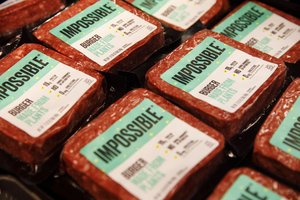
Most commercial investment has come from venture capital. Start-ups such as Beyond Meat and Impossible Foods attracted large sums during the boom years, but enthusiasm has waned. Global funding for alternative proteins fell from around $5bn in 2021 to less than half that by 2023, and Beyond Meat’s share price has dropped more than 90 per cent from its peak.
Some private equity funds have also begun backing companies that have proven supermarket sales rather than experimental technologies. Large agribusinesses are hedging as well: Tyson Foods and Cargill have invested in plant-based start-ups, while JBS has committed money to cultivated meat — real animal cells that are grown in bioreactors rather than on farms.