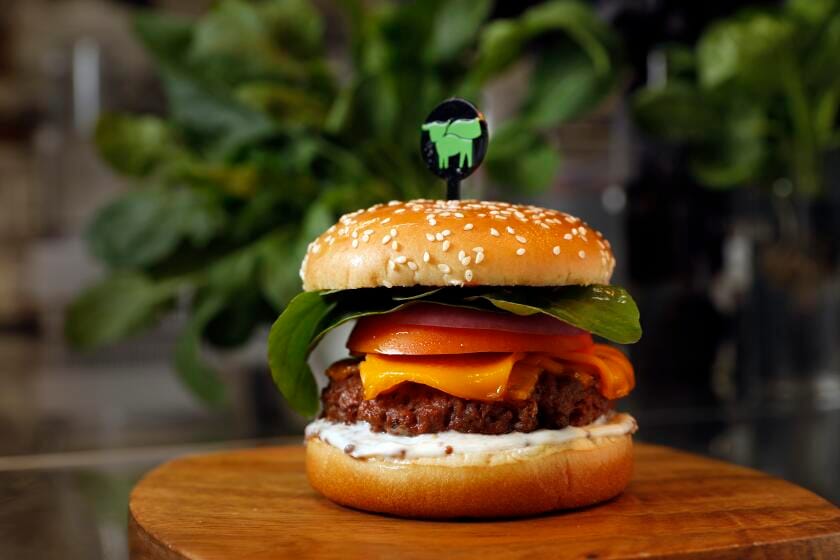
Beyond Meat, the El Segundo pioneer of plant-based hamburger patties, saw its stock collapse this week after it finalized a deal to reduce its debt. Above, a Beyond Meat burger prepared at the company’s research center and test kitchen. (Carolyn Cole / Los Angeles Times)
What does it cost a company when it’s no longer in the zeitgeist? For stockholders in Beyond Meat, perhaps as much as 99% of their money, if they bought at the top of the market.
Shares of the El Segundo maker of plant-based meats, an investors’ darling a few year ago, collapsed this week to less than $1 after the company wrapped up a deal to reduce its debt burden. The deal involves issuing up to 326 million new shares to the note holders.
The stock-diluting deal was spurred by declining sales at the company, which makes pea-based foods that mimic the taste of beef, chicken and pork.
It’s a stark reversal for Beyond Meat, whose products were in big demand early in the COVID-19 pandemic but are now less so as consumer tastes have shifted back to animal meats amid a surge of interest in protein.
“Animal meats are in the true cyclical fashion of consumer trends, having a moment that currently leaves less room for our products and brand,” founder and Chief Executive Ethan Brown told analysts during the company’s August conference call. “You’ve got these cultural moments that occur. And we happen to be on the other side of the particular moment.”
Beyond Meat went public in 2019 in an initial stock offering that saw its shares almost triple in price and then hit nearly $235 within months, as the public, restaurant chains and the media alike were captivated by the new food technology, which made plant-based burgers more than just palatable.
After that initial wave of interest, however, a number of its high-profile restaurant deals petered out and the company experienced a steady decline in sales from a peak of $465 million in 2021 to $326 million last year — all while never earning a profit. Second-quarter sales were off 20%, losing the company $29.2 million.
Shares closed at 67 cents Wednesday, down 14%.
Beyond Meat also faces competition from chief rival Impossible Foods in Redwood City, Calif., which has made sales gains at supermarkets and is available as a Whopper at Burger King.
Beyond Meat has not been alone in its struggles. The entire U.S. plant-based meat and seafood industry saw a 28% drop in unit sales and an 18% drop in revenue to $1.17 billion over the last two years, according to a report by the Good Food Institute, a nonprofit that advocates for alternative proteins. The downturn also hit markets outside the United States.
Inflation at the supermarket has made U.S. consumers less willing to buy premium-priced products, including plant-based proteins. That led some markets to move the products from refrigerated displays next to animal meats to the freezer, where they are harder to find, according to the report.
Emma Ignaszewski, the institute’s associate vice president of corporate engagement, said that although there may be a “protein boom,” she thinks that the plant-based companies can succeed if their products are positioned correctly.
“Plant-based proteins really need more investment, more innovation to match conventional meat on the factors that matter most to consumers, and that’s taste, price and accessibility,” she said.
“These products …. often cost two to three to four times more than their conventional counterparts,” she added. “So when the wallet’s hurting, this is not where people are turning to. Also, many products continue to lag consumer expectations on taste.”
Beyond Meat did not respond to emails for comment, but Brown laid out his plan for boosting sales and turning a profit during the last conference call.
The company has been reducing its head count, and in August laid off 44 more employees, or about 6% of its total global workforce. It also hired a “chief transformation officer” who will focus on reducing operating expenses and increasing efficiency.
However, key to the company’s comeback are new product offerings, amid a growing consumer dislike of processed foods — a tag that has stuck with plant-based meats after a public relations campaign by the meat lobby. Brown calls it a “headwind of misinformation.”
U.S. Health Secretary Robert F. Kennedy Jr.’s Make America Healthy Again movement also has targeted processed foods.
Last year, the company released a new version of its flagship Beyond Burger that reduced its saturated fat content, and a product line called Beyond Sun Sausage with fewer and less-processed ingredients.
It also has tested a new product called Beyond Ground that has only a handful of ingredients, including faba bean and potato protein. Brown told analysts that the test went well on the company’s social channels. And it has released a steak filet at select restaurants.
The company wants to reduce prices, as well as to “counter misinformation around our products,” Brown said. Last year, its new burger earned endorsements by the American Diabetes Assn. and Good Housekeeping. The American Heart Assn. has included the product in its recipe collection.
“We know that the extreme nature of the current renaissance around animal protein will, as consumer trends do, moderate,” Brown told analysts. “This moderation may occur solely with time, new information or new trends, or may be spurred on by a set of related factors, including pricing pressure, droughts and genetic disease outbreaks.”
ECJ overturns French ban on words like ‘steak’ or ‘bacon’ to describe plant-based food. The European Court of Justice (ECJ) determined on Friday, October 4, […]
With regulatory approval in Singapore and Australia, Vow is expanding its cultured meat business in APAC, debuting novel quail formats in both markets The Sydney-based […]
This fall, McDonald’s, the world’s biggest purveyor of beef burgers, put what might be the antithesis of its famous Quarter Pounder on the menu: the […]