Foundation plantings often are overlooked and under-appreciated, but they don’t have to be utilitarian and boring. The right foundation plants add instant curb appeal by providing color, texture and structure. A combination of evergreens and deciduous plants including small shrubs, perennials, and ground covers can make a foundation planting bed interesting rather than humdrum. Here are the best foundation plants to consider to make your home’s exterior the envy of the neighborhood.
Factors To Consider When Choosing Foundation Plants
Although there’s no set rule, planting about a third to half evergreens with the remaining deciduous shrubs and perennials sets you up for year-round appeal. Plant the tallest items at the back of the bed, tapering down to the shortest ones at the front of the planting area closest to the walk. Space plants adequately so that there’s at least one plant’s-width between the house and other plantings.
Most importantly, read plant tags and descriptions, and pay attention to your plant’s overall mature size. That quart- or gallon-sized pot doesn’t take up much space now, but you don’t want to create a maintenance nightmare in a few years. Overgrown is never a good look, and you don’t want to plant something to prune it back if it gets too big. Finally, make sure the plant is suited to survive conditions in your USDA Plant Hardiness Zone.
Carex
Southern Living Plant Collection
- Botanical Name: Carex spp.
- Sun Exposure: Shade to part shade
- Soil Type: Average, well-drained, moist
- Soil pH: 5.5-7.5
Carex, or sedges, are grass-like, mounding plants that offer year-round textural interest and color. Most sedges adapt well to shade or part shade and look best when planted as an edging plant or in mass plantings. There are many different varieties, but ‘Everillo’ has attractive lime green and golden foliage, while ‘Everest’ has pretty white markings. Grow them in USDA Plant Hardiness Zones 5a-9b.
Spirea
Getty Images
- Botanical Name: Spiraea spp.
- Sun Exposure: Full, partial
- Soil Type: Average but well-draining
- Soil pH: 6.0-7.0
Spireas are some of the easiest flowering shrubs to grow because they’re tolerant of many different types of soils and conditions. They’re fast-growing, and many can become quite large, topping out at 10 feet. Look for a dwarf variety for foundation plantings. Southern Living Plant Collection’s Little Bonnie has blue-green foliage and lavender-pink blooms, while Monrovia’s Double Play series includes varieties with blue or gold foliage. Most spireas can be grown in Zones 4-8, with some adapting to Zone 3 or 9.
Catmint
Getty Images
- Botanical Name: Nepeta x faassenii
- Sun Exposure: Full, partial
- Soil Type: Well-drained
- Soil pH: 6.5-7.5
You’d be hard-pressed to find a tougher plant than catmint. This perennial, which ranges from 10 to 20 inches tall and wide depending on the variety, blooms for months, rarely needs watering, and attracts pollinators all season long. It has a pleasant spicy-minty scent that discourages deer and rodents from devouring it. Planted in groupings, it’s a handsome middle or front of the border plant for any foundation planting in Zones 5-9. Look for well-behaved varieties that keep their upright forms, such as ‘Cat’s Pajamas’ and ‘Cat’s Meow.’
Abelia
- Botanical Name: Linnaea, previously known as Abelia
- Sun Exposure: Full, partial
- Soil Type: Well-drained but moist, organically rich
- Soil pH: 5.0-7.5
Handsome abelia hybrids often have colorful, variegated foliage and a nice mounding shape that stays around 2 to 6 feet tall and wide. Their parent plant, Chinese abelia, is much larger and less restrained in its growth. Abelia blooms profusely, attracting pollinators, but deer tend to avoid it. ‘Miss Lemon’ is especially pretty with yellow and green variegation and pink flowers, while ‘Kaleidoscope’ has gorgeous orange-red coloring with white flowers. Hardiness depends on the variety, but many can be grown in Zones 5-9.
Daylily
Getty Images
- Botanical Name: Hemerocallis spp.
- Sun Exposure: Full, partial
- Soil Type: Well-drained with organic matter
- Soil pH: 6.0-6.5
If you can’t grow anything else and live in Zones 3-9, try daylilies. These tough-as-nails perennials don’t mind poor soils and come in every color imaginable, ranging from 1 to 4 feet tall. Flowers can be a petite 2 inches up to 8 inches across. If you have scorching Southern summers, your daylilies will benefit from light afternoon shade and consistent watering. They’re a favorite of deer, so choose a different plant if deer visit your garden frequently. ‘Happy Returns,’ ‘Dragon’s Eye,’ and ‘Barbara Mitchell’ offer reliable blooms in the heat.
Agapanthus
Getty Images
- Botanical Name: Agapanthus
- Sun Exposure: Full
- Soil Type: Sandy, loamy, well-drained
- Soil pH: 5.5-7.5
Also called lily of the Nile, this pretty perennial has evergreen strappy leaves and lovely blue, purple, or white blooms that attract pollinators from spring to fall in frost-free climates. Agapanthus is especially attractive when planted in groupings at the front of borders in Zones 8-11. It ranges from a foot to 18 inches tall, depending on the variety. Hummingbirds and bees love it. Look for ‘Ever White’ and ‘Ever Sapphire’ as true stand-outs in your foundation plantings bed.
Panicle Hydrangea
Martina Simonazzi/Getty Images
- Botanical Name: Hydrangea paniculata
- Sun Exposure: Full, partial
- Soil Type: Well-drained
- Soil pH: 5.0-8.0
Panicle hydrangeas are some of the most reliable bloomers, flowering on new (this year’s) growth, so you won’t risk cutting off the flowers if you prune in the spring. They are more tolerant of heat, soil type, and sun than other hydrangeas, making them lower maintenance to care for. They grow in Zones 3-9. Varieties like ‘Limelight’ can be grown in Zone 9. Panicle hydrangeas come in a staggering array of varieties, but newer dwarf types are just right for foundation plantings. Give them four to six hours of sun for best flowering, with afternoon shade in hot climates (Zones 7 and warmer). Water during hot weather for the best-looking plants.
Boxwood
Cora Niele/ Getty Images
- Botanical Name: Buxus spp.
- Sun Exposure: Partial, dappled, full
- Soil Type: Average, well-drained but moist
- Soil pH: 6.5-7.5
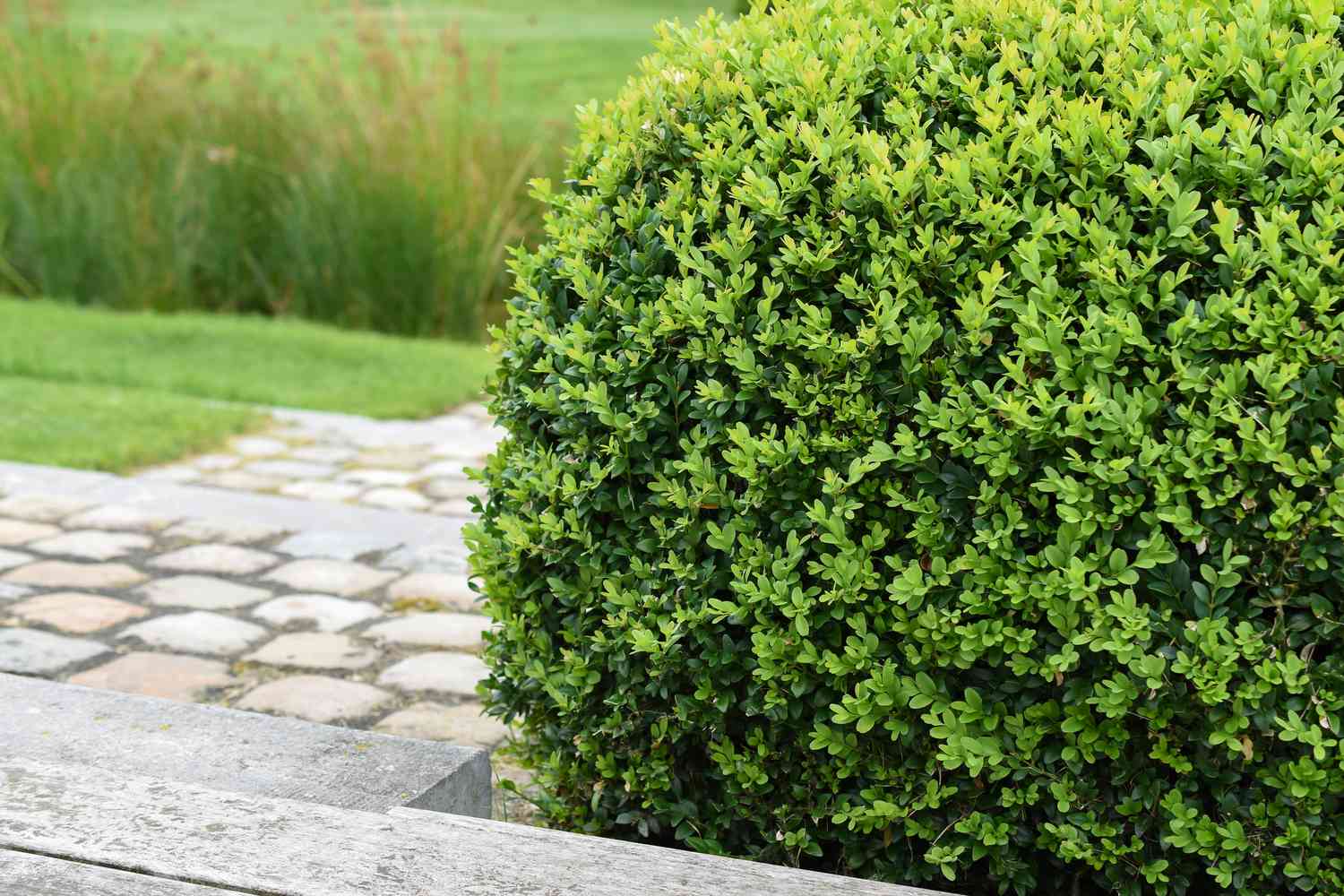
These shrubs are classics for a reason: They’re evergreen, they’re less tasty to deer than many other types, and there are many different cultivars available in different sizes. Some types of boxwoods can be sheared to shape, while other varieties can be left natural. Consider ‘Baby Gem,’ which reaches 3 to 4 feet tall and wide, or ‘Sprinter’ which is a fast grower, retains its shape, and maxes out at 2 to 4 feet tall and wide. Most varieties can be grown in Zones 5-9.
Deutzia
Getty Images
- Botanical Name: Deutzia
- Sun Exposure: Full sun
- Soil Type: Fertile, moist, well-draining
- Soil pH: 6.0 – 8.0
Deutzia is a real show-stopper in the spring with beautiful bell-like flowers that pollinators love. Some varieties of this deciduous shrub become quite large, but others measure just 1 to 2 feet tall and wide. ‘Yuki Cherry Blossom’ is an especially lovely, low-growing type. They can be grown in Zones 5-8.
Inkberry Holly
- Botanical Name: Ilex glabra
- Sun Exposure: Full, partial
- Soil Type: Clay, sandy, well-drained, moist
- Soil pH: 4.5-6.0
Inkberry holly is a native alternative to boxwood that can withstand heat throughout the South. This evergreen shrub is a good choice for coastal homes as it tolerates salt and occasionally wet soil. The pretty, glossy evergreen foliage forms a soft and dense rounded mound that can be pruned or left to grow natural. Berries are dark rather than red. New varieties such as ‘Gem Box’ stay 2 to 4 feet tall and wide, while ‘Strong Box’ reaches 3 feet tall and wide for the perfect small foundation planting. Use this foundation plant in Zones 4a-11b.
Stonecrop
- Botanical Name: Hylotelephium
- Sun Exposure: Full
- Soil Type: Clay, sandy, well-drained
- Soil pH: 6.0-7.5
The old standby, ‘Autumn Joy,’ has been popular for decades for a reason. Give this succulent perennial full sun and well-drained soil, and you can practically walk away. Stonecrop also attracts every pollinator around and blooms vigorously in late summer or fall. New stonecrop varieties like ‘Lime Joy’ and ‘Midnight Velvet’ have expanded the available foliage and flower colors and can be grown in Zones 3-9.
Weigela
Federica Grassi/Getty
- Botanical Name: Weigela florida
- Sun Exposure: Full
- Soil Type: Well-drained, moist
- Soil pH: 5.5-7.5
Spring is when this deciduous shrub shines, blanketed in trumpet-shaped flowers for a couple of weeks (some varieties bloom again in sporadic waves) in Zones 4-8. Prune weigela just after blooming since it forms buds on old wood. Some of our favorite cultivars have burgundy foliage and intensely pink blossoms, like Proven Winner’s ‘Fine Wine.’ You can also find variegated varieties and flowers in lavenders or white. Cultivars can top out at 6 feet, 3 feet, or even shorter, depending on whether you want to plant them in the back or front of the border.
Hosta
- Botanical Name: Hosta
- Sun Exposure: Partial shade, full shade
- Soil Type: Well-drained but moist, organically rich
- Soil pH: 6.0-7.0
Hostas come in such a wide array of sizes, shapes, and colors, you can create a beautifully textured foundation planting with these foliage plants alone. Place a few evergreen shrubs in the backdrop, then layer in varieties with blue, lemon- or white-striped, gold, and green foliage. Experiment with heart-shaped, cup-shaped, and long, twisted leaves. Many varieties come in the 18-24 inch range, while miniatures with ‘Mouse’ in the name are absolutely charming in the front of the border. Hostas can be grown in Zones 3-8 but need more shade in Southern gardens.
Azalea
- Botanical Name: Rhododendron spp.
- Sun Exposure: Partial shade, dappled or filtered shade
- Soil Type: Well-drained but moist, organically rich
- Soil pH: 4.5-6.0
For many gardeners, blooming azaleas are what defines a Southern spring. Azaleas can be very long-lived and reach massive proportions. The popular Encore azaleas stay at a manageable 2 to 5 feet tall, and also have the advantage of blooming again in fall. Azalea hybrids don’t bloom well in deep shade, but they can scorch in full sun. The Goldilocks zone is filtered sunlight under a tall tree. They must have acidic, well-drained soil to thrive in Zones 5-9.
Plum Yew
- Botanical Name: Cephalotaxus harringtonia
- Sun Exposure: Partial, full shade
- Soil Type: Well-drained but moist
- Soil pH: 5.0-7.0
Plum yews are ideal evergreens for the Southeast because they can handle the heat and humidity that other yews can’t. They should only be planted in full sun if you experience cool summers. The soft, fine-needled shrubs come in a variety of shapes and sizes and can be grown in Zones 6-9. Plant ‘Prostrata’ along the front of your foundation planting, or more upright varieties like ‘Yewtopia’ plum yew and ‘Duke Gardens’ in the back. Both grow slowly to about 4 feet tall.
Gardenia
Santiago Urquijo / Getty
- Botanical Name: Gardenia jasminoides
- Sun Exposure: Full, partial
- Soil Type: Moist, well-drained, rich, loamy, sandy, clay
- Soil pH: 5.0-6.5
Plant gardenias in your front beds to be rewarded with their sweet fragrance during spring and summer blooming. Waxy white or cream flowers are 1 to 3 inches and known for their scent, and dark evergreen leaves provide year-round interest. They mature at 3 to 8 feet tall and wide, depending on the variety. Plant in rich, acidic, well-draining soil in Zones 7-11. They like dappled sunlight and a break from hot afternoon sun. Gardenias are mildly toxic to cats, dogs, and horses.
Indian Hawthorn
- Botanical Name: Rhaphiolepis indica
- Sun Exposure: Full
- Soil Type: Well-drained, moist, clay, loamy, sandy
- Soil pH: 6.0-7.5
Known for delicate white flowers, this evergreen grows in coastal areas and doesn’t mind the Southern sun. Grow this shrub in Zones 8-10 in acidic or alkaline soil. Spring blooms are white or pink with five petals and pink-red stamens. These perennial shrubs attract birds with berries and other pollinators are attracted to the nectar. These make good foundation plants since they mature at 4 to 6 feet tall and wide. They may not be a good choice if you have a lot of deer in your area because deer like to browse these plants.