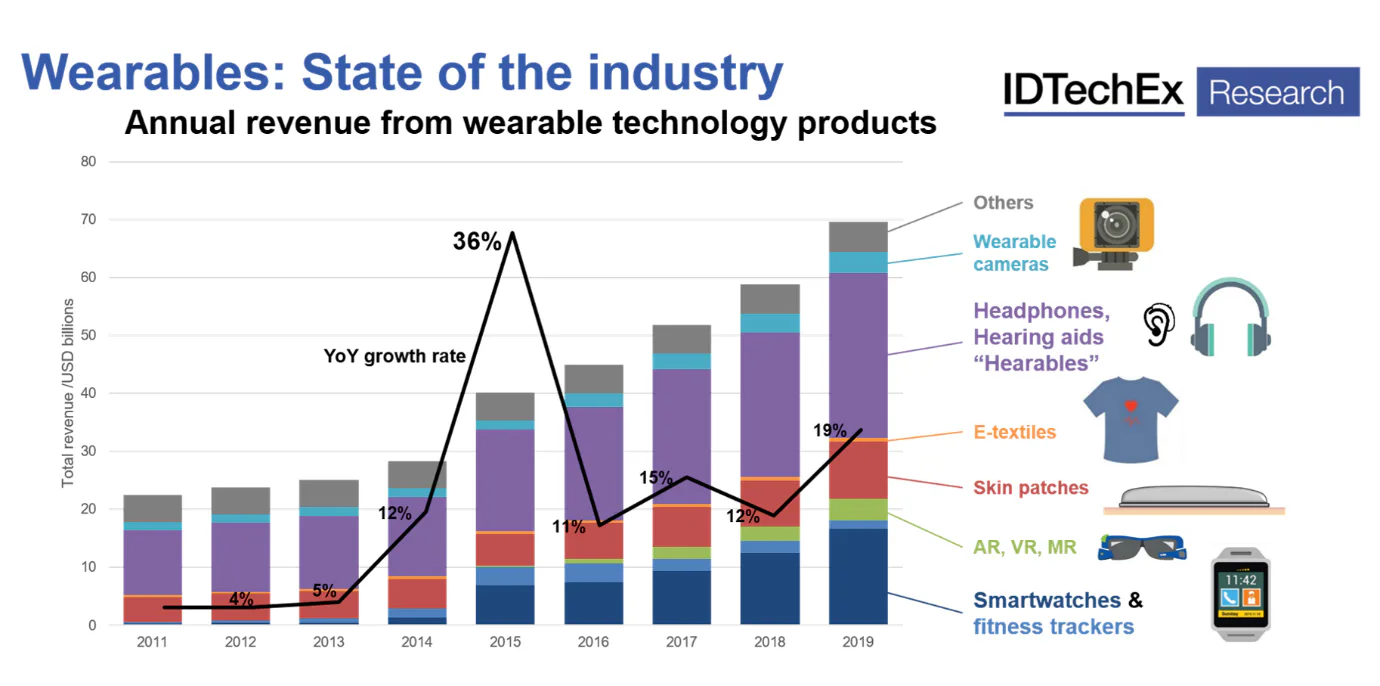
1. 2019 saw the largest single year growth rate for wearable technology product revenue since 2015
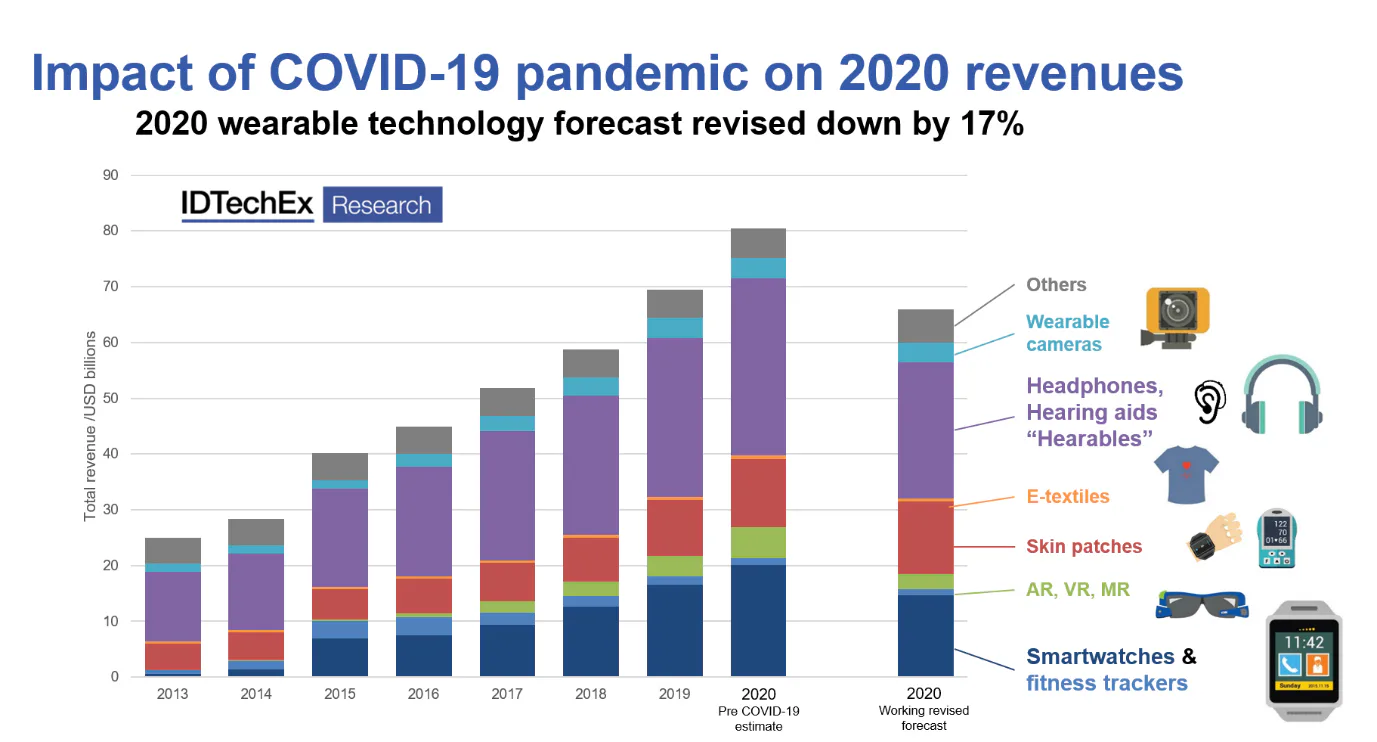
2. COVID-19 has already had a significant impact on 2020 revenues, but many sectors retain long-term optimism
The COVID-19 pandemic continues to have a profound societal and economic impact, and many wearable products have been part of this. The most critical impact to date has been at the point-of-sale for many products, with lockdowns and social distancing measures meaning that stores are closed, doctors appointments are not taking place in person and sales of many products have been significantly impacted as a result. However, the impact has been very varied; where some products have seen as much as an 80% reduction in sales for Q2 2020 vs Q2 2019, other areas such as remote patient monitoring devices have been accelerated onto the market to assist in pandemic countermeasures.
3. Specific regulatory changes coming in 2020 and 2021 will have a significant impact in skin patches, hearables and beyond
4. Technology giants target the move from consumer to medical, with wearables as a key ingredient
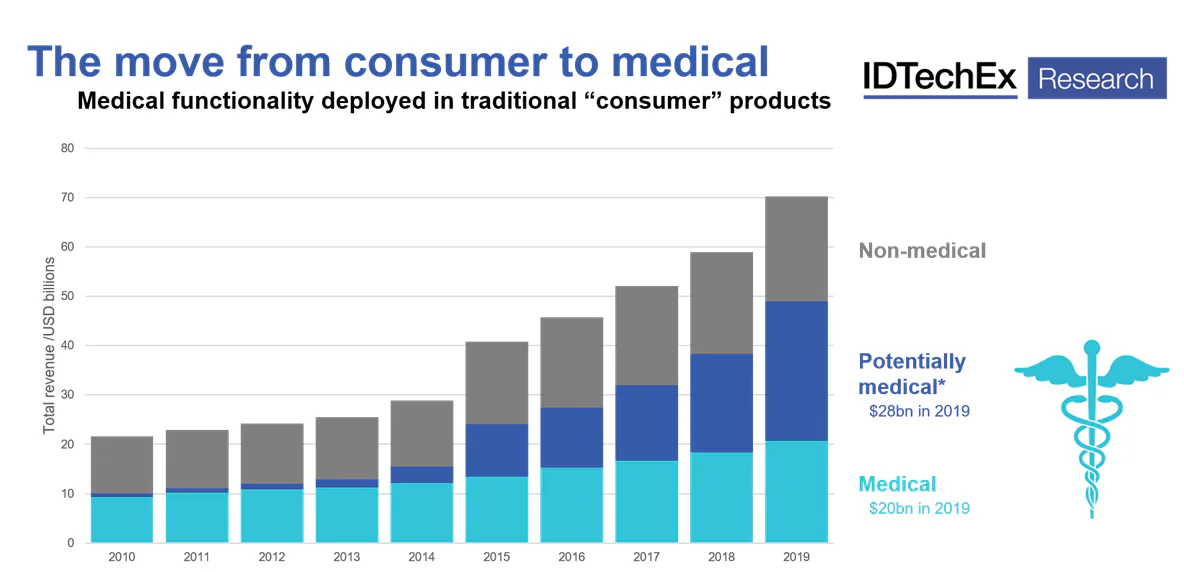
However, the critical point here is that these metrics are not just exclusive to medical devices. In many cases, products are having versions of these features added as part of a standard consumer offerings, complete with appropriate disclaimers that encourage users to consult their doctor if they have challenges. However, when this development is paired with intensive lobbying, as well as significant parallel development of the data infrastructure and supporting systems required for medical devices, it is clear that the longer-term strategy will move in this direction. The wearable devices at the core of this are an essential part of the long-term strategy, and the technology within them is being developed at a remarkable rate.
The chart below illustrates this trend within wearable product data. “Potentially medical” products are product categories where sensing capabilities more traditionally associated with medical devices have been introduced in consumer products, which could potentially see some reclassification within the boundaries of medical products further into the future. This is not likely to happen quickly, but this is a significant trend which should not be ignored, regardless of which side of the debate you fall on.
5. From single parameter to multi-parameter sensing
The role of a medical device for sensing is typically to represent one physiological parameter as accurately and reliably as possible. A doctor would then use an appropriate combination of medical device readings and other tests to make an assessment and determine the best course of action. However, as digital health and artificial intelligence (see IDTechEx report on this topic here) are increasingly introduced, the capabilities of medical devices are being expanded such that they can diagnose and monitor specific conditions with increasing independence from the doctor.
This trend goes hand in hand with increasing adoption of multi-parametric sensing on medical devices. Whilst these are not necessarily new, it is still the case that the majority of medical device categories (and particularly those studied within wearables) focus on a single parameter, such as blood glucose, cardiac biopotential, skin temperature, blood pressure and so on. Multi-parameter sensing often presents a much more significant challenge, particularly in navigating regulatory barriers, with companies forced to weigh up the advantages of the new capabilities offered with the significant investment to go through de novo regulatory approval processes which take significantly more time and money.
However, as more pioneers begin to introduce advanced features enabled digital health and AI, these multi-parametric systems will increasingly become the norm. This will have a significant impact on the status quo for many of the product sectors as they exist today, but the change is expected to be a gradual evolution over years and decades. This also goes hand in hand with the previous point; many of the fitness and wellness devices are already using combinations of many different biometric readings to build a more complete picture of the wearer’s health. It will just take significantly more time and money for these advances to have their efficacy and safety proven within the context of medical devices too.
|