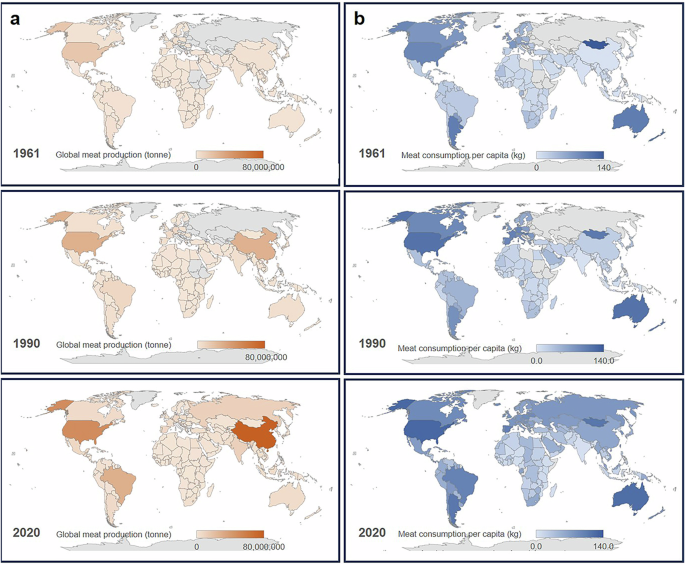
Ritchie, H., Rosado, P. & Roser, M. Meat and dairy production (Our World In Data, 2017).
Bonny, S. P. F., Gardner, G. E., Pethick, D. W. & Hocquette, J.-F. What is artificial meat and what does it mean for the future of the meat industry? J. Integr. Agric 14, 255–263 (2015).
Parlasca, M. C. & Qaim, M. Meat consumption and sustainability. Annu Rev. Resour. Econ. 14, 17–41 (2022).
Godfray, H. C. J. et al. Meat consumption, health, and the environment. Science 361, https://doi.org/10.1126/science.aam5324 (2018).
González, N., Marquès, M., Nadal, M. & Domingo, J. L. Meat consumption: Which are the current global risks? A review of recent (2010–2020) evidences. Food Rev. Int. 137, 109341 (2020).
Bhat, Z. F., Morton, J. D., Mason, S. L., Bekhit, A. E. A. & Bhat, H. F. Technological, regulatory, and ethical aspects of in vitro meat: A future slaughter-free harvest. Compr. Rev. Food Sci. Food Saf. 18, 1192–1208 (2019).
Springmann, M. et al. Options for keeping the food system within environmental limits. Nature 562, 519–525 (2018).
Neacsu, M., McBey, D. & Johnstone, A. M. In Sustainable Protein Sources (eds Nadathur, S. R., Wanasundara, J. P. D., & Scanlin, L.) 359–375 (Academic Press, 2017).
Li, Y. Feeding the future: Plant-based meat for global food security and environmental sustainability. Cereal Foods World 65, 8–11 (2020).
Kaluza, J., Harris, H., Linden, A. & Wolk, A. Long-term unprocessed and processed red meat consumption and risk of chronic obstructive pulmonary disease: a prospective cohort study of women. Eur. J. Nutr. 58, 665–672 (2019).
Molotoks, A., Smith, P. & Dawson, T. P. Impacts of land use, population, and climate change on global food security. Food Energy Secur. 10, e261 (2021).
Flint, M., Bowles, S., Lynn, A. & Paxman, J. R. Novel plant-based meat alternatives: future opportunities and health considerations. Proc. Nutr. Soc. 82, 370–385 (2023).
Rubio, N. R., Xiang, N. & Kaplan, D. L. Plant-based and cell-based approaches to meat production. Nat. Commun. 11, 6276 (2020).
Sha, L. & Xiong, Y. L. Plant protein-based alternatives of reconstructed meat: Science, technology, and challenges. Trends Food Sci. Technol. 102, 51–61 (2020).
Ahmad, M. I., Farooq, S., Alhamoud, Y., Li, C. & Zhang, H. A review on mycoprotein: History, nutritional composition, production methods, and health benefits. Trends Food Sci. Technol. 121, 14–29 (2022).
Hashempour-Baltork, F., Khosravi-Darani, K., Hosseini, H., Farshi, P. & Reihani, S. F. S. Mycoproteins as safe meat substitutes. J. Clean. Prod. 253, 119958 (2020).
Day, L., Cakebread, J. A. & Loveday, S. M. Food proteins from animals and plants: Differences in the nutritional and functional properties. Trends Food Sci. Technol. 119, 428–442 (2022).
Fu, Y. et al. The potentials and challenges of using microalgae as an ingredient to produce meat analogues. Trends Food Sci. Technol. 112, 188–200 (2021).
O’Neill, E. N., Cosenza, Z. A., Baar, K. & Block, D. E. Considerations for the development of cost-effective cell culture media for cultivated meat production. Compr. Rev. Food Sci. Food Saf. 20, 686–709 (2021).
Ben-Arye, T. et al. Textured soy protein scaffolds enable the generation of three-dimensional bovine skeletal muscle tissue for cell-based meat. Nat. Food 1, 210–220 (2020).
Bomkamp, C. et al. Scaffolding Biomaterials for 3D Cultivated Meat: Prospects and Challenges. Adv. Sci. 9, 2102908 (2022).
Post, M. J. An alternative animal protein source: cultured beef. Ann. N. Y. Acad. Sci. 1328, 29–33 (2014).
Wongkanya, R. et al. Electrospinning of alginate/soy protein isolated nanofibers and their release characteristics for biomedical applications. J. Sci: Adv. Mater. Devices 2, 309–316 (2017).
Post, M. J. et al. Scientific, sustainability and regulatory challenges of cultured meat. Nat. Food 1, 403–415 (2020).
Chriki, S. & Hocquette, J. F. The myth of cultured meat: A review. Front. Nutr. 7, 7 (2020).
Tuomisto, H. L. The eco‐friendly burger. EMBO Rep. 20, e47395 (2019).
David, S. et al. Co-culture approaches for cultivated meat production. Nat. Rev. Bioeng. https://doi.org/10.1038/s44222-023-00077-x (2023).
Jones, N. Lab-grown meat: the science of turning cells into steaks and nuggets. Nature 619, 22–24 (2023).
Papastavropoulou, K., Xiao, J. & Proestos, C. Edible insects: Tendency or necessity (a review). eFood 4, e58 (2023).
Committee, E. S. Risk profile related to production and consumption of insects as food and feed. EFSA J. 13, 4257 (2015).
Liceaga, A. M. Processing insects for use in the food and feed industry. Curr. Opin. Insect Sci. 48, 32–36 (2021).
Zhang, T. et al. The development history and recent updates on soy protein-based meat alternatives. Trends Food Sci. Technol. 109, 702–710 (2021).
Zhang, S., Kim, N., Yokoyama, W. & Kim, Y. K. Effects of moisture content on mechanical properties, transparency, and thermal stability of yuba film. Food Chem. 243, 202–207 (2018).
Baune, M.-C., Terjung, N., Tülbek, M. Ç. & Boukid, F. Textured vegetable proteins (TVP): Future foods standing on their merits as meat alternatives. Fut. Foods 6, 100181 (2022).
Finnigan, T. J. A. et al. Mycoprotein: The future of nutritious nonmeat protein, a symposium review. Curr. Dev. Nutr. 3, nzz021 (2019).
Hidayat, B., Wea, A. & Andriati, N. Physicochemical, sensory attributes and protein profile by SDS-PAGE of beef sausage substituted with texturized vegetable protein. J. Food Sci. 2, 20–31 (2017).
Bakhsh, A., Lee, S.-J., Lee, E.-Y., Hwang, Y.-H. & Joo, S.-T. Evaluation of rheological and sensory characteristics of plant-based meat analog with comparison to beef and pork. Food Sci. Anim. Resour. 41, 983–996 (2021).
Mateen, A., Mathpati, M. & Singh, G. A study on high moisture extrusion for making whole cut meat analogue: Characterization of system, process and product parameters. Innov. Food Sci. Emerg. Technol. 85, 103315 (2023).
Wiebe, M. G. Myco-protein from Fusarium venenatum: a well-established product for human consumption. Appl. Microbiol Biotechnol. 58, 421–427 (2002).
Schmid, E. M., Farahnaky, A., Adhikari, B. & Torley, P. J. High moisture extrusion cooking of meat analogs: A review of mechanisms of protein texturization. Compr. Rev. Food Sci. Food Saf. 21, 4573–4609 (2022).
Guan, J., Porter, D., Tian, K., Shao, Z. & Chen, X. Morphology and mechanical properties of soy protein scaffolds made by directional freezing. J. Appl Polym. Sci. 118, 1658–1665 (2010).
Dekkers, B. L., Boom, R. M. & van der Goot, A. J. Structuring processes for meat analogues. Trends Food Sci. Technol. 81, 25–36 (2018).
Zhang, J., Chen, Q., Kaplan, D. L. & Wang, Q. High-moisture extruded protein fiber formation toward plant-based meat substitutes applications: Science, technology, and prospect. Trends Food Sci. Technol. 128, 202–216 (2022).
Zhang, J. et al. Changes in conformation and quality of vegetable protein during texturization process by extrusion. Crit. Rev. Food Sci. Nutr. 59, 3267–3280 (2019).
Sun, C., Fu, J., Chang, Y., Li, S. & Fang, Y. Structure design for improving the characteristic attributes of extruded plant-based meat analogues. Food Biophys. 17, 137–149 (2022).
Aschemann-Witzel, J., Gantriis, R. F., Fraga, P. & Perez-Cueto, F. J. A. Plant-based food and protein trend from a business perspective: markets, consumers, and the challenges and opportunities in the future. Crit. Rev. Food Sci. Nutr. 61, 3119–3128 (2021).
Webb, L., Fleming, A., Ma, L. & Lu, X. Uses of cellular agriculture in plant-based meat analogues for improved palatability. ACS Food Sci. Technol. 1, 1740–1747 (2021).
Pinckaers, P. J. M., Trommelen, J., Snijders, T. & van Loon, L. J. C. The anabolic response to plant-based protein ingestion. Sports Med. 51, 59–74 (2021).
Schreuders, F. K. G. et al. Mapping the texture of plant protein blends for meat analogues. Food Hydrocoll. 118, 106753 (2021).
Sui, X., Zhang, T. & Jiang, L. Soy protein: Molecular structure revisited and recent advances in processing technologies. Ann. Rev. Food Sci. Technol. 12, 119–147 (2021).
van den Berg, L. A., Mes, J. J., Mensink, M. & Wanders, A. J. Protein quality of soy and the effect of processing: A quantitative review. Front. Nutr. 9, 1004754 (2022).
Bohrer, B. M. An investigation of the formulation and nutritional composition of modern meat analogue products. Food Sci. Hum. Wellness 8, 320–329 (2019).
Peng, H. et al. High moisture extrusion of pea protein: Effect of l-cysteine on product properties and the process forming a fibrous structure. Food Hydrocoll. 129, 107633 (2022).
Younis, K., Ashfaq, A., Ahmad, A., Anjum, Z. & Yousuf, O. A critical review focusing the effect of ingredients on the textural properties of plant-based meat products. J. Texture Stud. 54, 365–382 (2022).
Shen, Y., Hong, S., Singh, G., Koppel, K. & Li, Y. Improving functional properties of pea protein through “green” modifications using enzymes and polysaccharides. Food Chem. 385, 132687 (2022).
Akharume, F. U., Aluko, R. E. & Adedeji, A. A. Modification of plant proteins for improved functionality: A review. Compr. Rev. Food Sci. Food Saf. 20, 198–224 (2021).
Hussain, M. et al. Potato protein: An emerging source of high quality and allergy free protein, and its possible future based products. Food Rev. Int. 148, 110583 (2021).
Zheng, L., Regenstein, J. M., Wang, Z., Zhang, H. & Zhou, L. Reconstituted rice protein: The raw materials, techniques and challenges. Trends Food Sci. Technol. 133, 267–276 (2023).
Vatansever, S., Tulbek, M. C. & Riaz, M. N. Low-and high-moisture extrusion of pulse proteins as plant-based meat ingredients: A review. Cereal Foods World 65, 12–14 (2020).
Shrestha, S., van ‘t Hag, L., Haritos, V. S. & Dhital, S. Lentil and Mungbean protein isolates: Processing, functional properties, and potential food applications. Food Hydrocoll. 135, 108142 (2023).
Augustin, M. A. & Cole, M. B. Towards a sustainable food system by design using faba bean protein as an example. Trends Food Sci. Technol. 125, 1–11 (2022).
Sá, A. G. A., Silva, D. C. D., Pacheco, M. T. B., Moreno, Y. M. F. & Carciofi, B. A. M. Oilseed by-products as plant-based protein sources: Amino acid profile and digestibility. Future Foods 3, 100023 (2021).
Kotecka-Majchrzak, K., Sumara, A., Fornal, E. & Montowska, M. Oilseed proteins – Properties and application as a food ingredient. Trends Food Sci. Technol. 106, 160–170 (2020).
Rivero Meza, S. L. et al. A review on amaranth protein: composition, digestibility, health benefits and food industry utilisation. Int J. Food Sci. Technol. 58, 1564–1574 (2023).
Lingiardi, N., Galante, M., de Sanctis, M. & Spelzini, D. Are quinoa proteins a promising alternative to be applied in plant-based emulsion gel formulation? Food Chem. 394, 133485 (2022).
Matos, Â. P., Novelli, E. & Tribuzi, G. Use of algae as food ingredient: sensory acceptance and commercial products. Front. Food. Sci. Technol. 2, https://doi.org/10.3389/frfst.2022.989801 (2022).
Raja, K., Kadirvel, V. & Subramaniyan, T. Seaweeds, an aquatic plant-based protein for sustainable nutrition – A review. Fut. Foods 5, 100142 (2022).
Tan, Y., Lee, P. W., Martens, T. D. & McClements, D. J. Comparison of emulsifying properties of plant and animal proteins in oil-in-water emulsions: Whey, soy, and RuBisCo proteins. Food Biophys. 17, 409–421 (2022).
Grácio, M., Oliveira, S., Lima, A. & Boavida Ferreira, R. RuBisCO as a protein source for potential food applications: A review. Food Chem. 419, 135993 (2023).
Boukid, F. Plant-based meat analogues: from niche to mainstream. Eur. Food Res. Technol. 247, 297–308 (2021).
Zhou, H., Hu, Y., Tan, Y., Zhang, Z. & McClements, D. J. Digestibility and gastrointestinal fate of meat versus plant-based meat analogs: An in vitro comparison. Food Chem. 364, 130439 (2021).
Penna Franca, P. A., Duque-Estrada, P., da Fonseca e Sá, B. F., van der Goot, A. J. & Pierucci, A. P. T. R. Meat substitutes – past, present, and future of products available in Brazil: changes in the nutritional profile. Fut. Foods 5, 100133 (2022).
Crimarco, A. et al. A randomized crossover trial on the effect of plant-based compared with animal-based meat on trimethylamine-N-oxide and cardiovascular disease risk factors in generally healthy adults: Study with appetizing plantfood—meat eating alternative trial (SWAP-MEAT). Am. J. Clin. Nutr. 112, 1188–1199 (2020).
Bühler, J. M., Schlangen, M., Möller, A. C., Bruins, M. E. & van der Goot, A. J. Starch in plant-based meat replacers: A new approach to using endogenous starch from cereals and legumes. Starch-Stärke 74, 2100157 (2022).
Chen, Q., Zhang, J., Zhang, Y., Kaplan, D. L. & Wang, Q. Protein-amylose/amylopectin molecular interactions during high-moisture extruded texturization toward plant-based meat substitutes applications. Food Hydrocoll. 127, 107559 (2022).
Fish, K. D., Rubio, N. R., Stout, A. J., Yuen, J. S. K. & Kaplan, D. L. Prospects and challenges for cell-cultured fat as a novel food ingredient. Trends Food Sci. Technol. 98, 53–67 (2020).
Kantanen, K. et al. Physical properties of extrudates with fibrous structures made of faba bean protein ingredients using high moisture extrusion. Foods 11, 1280 (2022).
Ubbink, J. & Muhialdin, B. J. Protein physical state in meat analogue processing. Curr. Opin. Food Sci. 45, 100822 (2022).
He, J., Evans, N. M., Liu, H. & Shao, S. A review of research on plant-based meat alternatives: Driving forces, history, manufacturing, and consumer attitudes. Compr. Rev. Food Sci. Food Saf. 19, 2639–2656 (2020).
Ramachandraiah, K. Potential development of sustainable 3D-printed meat analogues: A review. Sustainability 13, 938 (2021).
Cornet, S. H. V. et al. Apparent universality of leguminous proteins in swelling and fibre formation when mixed with gluten. Food Hydrocoll. 120, 106788 (2021).
Li, X. et al. Inkjet bioprinting of biomaterials. Chem. Rev. 120, 10793–10833 (2020).
Qiu, L., Zhang, M., Bhandari, B., Chitrakar, B. & Chang, L. Investigation of 3D printing of apple and edible rose blends as a dysphagia food. Food Hydrocoll. 135, 108184 (2023).
Mendes, A. C., Stephansen, K. & Chronakis, I. S. Electrospinning of food proteins and polysaccharides. Food Hydrocoll. 68, 53–68 (2017).
Pulatsu, E. et al. Restructuring cookie dough with 3D printing: Relationships between the mechanical properties, baking conditions, and structural changes. J. Food Eng. 319, 110911 (2022).
Pérez, B., Nykvist, H., Brøgger, A. F., Larsen, M. B. & Falkeborg, M. F. Impact of macronutrients printability and 3D-printer parameters on 3D-food printing: A review. Food Chem. 287, 249–257 (2019).
Osen, R., Toelstede, S., Wild, F., Eisner, P. & Schweiggert-Weisz, U. High moisture extrusion cooking of pea protein isolates: Raw material characteristics, extruder responses, and texture properties. J. Food Eng. 127, 67–74 (2014).
Schreuders, F. K. G. et al. Comparing structuring potential of pea and soy protein with gluten for meat analogue preparation. J. Food Eng. 261, 32–39 (2019).
Cherian, D. S., Bhuvan, T., Meagher, L. & Heng, T. S. P. Biological considerations in scaling up therapeutic cell manufacturing. Front Pharm. 11, 654 (2020).
Li, W. et al. Preparation of microcarriers based on zein and their application in cell culture. Mater. Sci. Eng. C. 58, 863–869 (2016).
Wang, C., Gong, Y., Lin, Y., Shen, J. & Wang, D.-A. A novel gellan gel-based microcarrier for anchorage-dependent cell delivery. Acta Biomater. 4, 1226–1234 (2008).
Kyriakopoulou, K., Keppler, J. K. & van der Goot, A. J. Functionality of ingredients and additives in plant-based meat analogues. Foods 10, https://doi.org/10.3390/foods10030600 (2021).
Van Loo, E. J., Caputo, V. & Lusk, J. L. Consumer preferences for farm-raised meat, lab-grown meat, and plant-based meat alternatives: Does information or brand matter? Food Policy 95, 101931 (2020).
Tanaka, R. I. et al. Production of scaffold-free cell-based meat using cell sheet technology. NPJ Sci. Food 6, 41 (2022).
Park, S. et al. Chitosan/cellulose-based porous nanofilm delivering C-Phycocyanin: A novel platform for the production of cost-effective cultured meat. ACS Appl Mater. Interfaces 13, 32193–32204 (2021).
Xu, Y., Peng, J., Richards, G., Lu, S. & Eglin, D. Optimization of electrospray fabrication of stem cell–embedded alginate–gelatin microspheres and their assembly in 3D-printed poly(ε-caprolactone) scaffold for cartilage tissue engineering. J. Orthop. Transl. 18, 128–141 (2019).
Levato, R. et al. Biofabrication of tissue constructs by 3D bioprinting of cell-laden microcarriers. Biofabrication 6, 035020 (2014).
Ozturk, O. K., Salgado, A. M., Holding, D. R., Campanella, O. H. & Hamaker, B. R. Dispersion of zein into pea protein with alkaline agents imparts cohesive and viscoelastic properties for plant-based food analogues. Food Hydrocoll. 134, 108044 (2023).
Ismail, B. P., Senaratne-Lenagala, L., Stube, A. & Brackenridge, A. Protein demand: review of plant and animal proteins used in alternative protein product development and production. Anim. Front. 10, 53–63 (2020).
Zhang, Z. et al. High-moisture extrusion technology application in the processing of textured plant protein meat analogues: a review. Food Rev. Int., 1–36, https://doi.org/10.1080/87559129.2021.2024223 (2022).
Tunnarut, D., Nopwinyuwong, A. & Tanakamolpradit, T. Quality improvement of plant-based patty using methylcellulose, κ-carrageenan and xanthan gum. J. Curr. Sci. Technol. 12, 327–335 (2023).
He, J., Liu, H., Balamurugan, S. & Shao, S. Fatty acids and volatile flavor compounds in commercial plant-based burgers. J. Food Sci. 86, 293–305 (2021).
Wang, B. et al. Insights into formation, detection and removal of the beany flavor in soybean protein. Trends Food Sci. Technol. 112, 336–347 (2021).
Li, X. & Li, J. The flavor of plant-based meat analogues. Cereal Foods World 65, https://doi.org/10.1094/CFW-65-4-0040 (2020).
Kuroda, M. In Kokumi Substance as an Enhancer of Koku: Biochemistry, Physiology, and Food Science (ed Motonaka K.) 255–258 (Springer Nature Singapore, 2024).
Faustman, C., Suman, S. P. & Ramanathan, R. In Lawrie’s Meat Science (Ninth Edition) (ed Toldrá, F.) 363–392 (Woodhead Publishing, 2023).
Botella-Martínez, C., Viuda-Martos, M., Fernández-López, J. A., Pérez-Alvarez, J. A. & Fernández-López, J. Development of plant-based burgers using gelled emulsions as fat source and beetroot juice as colorant: Effects on chemical, physicochemical, appearance and sensory characteristics. LWT 172, 114193 (2022).
Shao, Y. et al. High-level secretory production of leghemoglobin in Pichia pastoris through enhanced globin expression and heme biosynthesis. Bioresour. Technol. 363, 127884 (2022).
Chen, F. L., Wei, Y. M., Zhang, B. & Ojokoh, A. O. System parameters and product properties response of soybean protein extruded at wide moisture range. J. Food Eng. 96, 208–213 (2010).
Beniwal, A. S., Singh, J., Kaur, L., Hardacre, A. & Singh, H. Meat analogs: Protein restructuring during thermomechanical processing. Compr. Rev. Food Sci. Food Saf. 20, 1221–1249 (2021).
Samard, S., Gu, B. Y. & Ryu, G. H. Effects of extrusion types, screw speed and addition of wheat gluten on physicochemical characteristics and cooking stability of meat analogues. J. Sci. Food Agr. 99, 4922–4931 (2019).
Alessandrini, R. et al. Nutritional quality of plant-based meat products available in the UK: A cross-sectional survey. Nutrients 13, https://doi.org/10.3390/nu13124225 (2021).
Shaghaghian, S., McClements, D. J., Khalesi, M., Garcia-Vaquero, M. & Mirzapour-Kouhdasht, A. Digestibility and bioavailability of plant-based proteins intended for use in meat analogues: A review. Trends Food Sci. Technol. 129, 646–656 (2022).
Marinangeli, C. P. F., Miller, K. & Fulgoni, V. L. III Effect of increasing plant protein intake on protein quality and nutrient intake of US adults. Appl. Physiol. Nutr. Metab. 48, 49–61 (2022).
Meade, S. J., Reid, E. A. & Gerrard, J. A. The impact of processing on the nutritional quality of food proteins. J. AOAC Int. 88, 904–922 (2005).
Adamidou, S., Nengas, I., Grigorakis, K., Nikolopoulou, D. & Jauncey, K. Chemical composition and antinutritional factors of field peas (Pisum sativum), chickpeas (Cicer arietinum), and faba beans (Vicia faba) as affected by extrusion preconditioning and drying temperatures. Cereal Chem. 88, 80–86 (2011).
Omosebi, M. O., Osundahunsi, O. F. & Fagbemi, T. N. Effect of extrusion on protein quality, antinutritional factors, and digestibility of complementary diet from quality protein maize and soybean protein concentrate. J. Food Biochem. 42, e12508 (2018).
Popova, A. & Mihaylova, D. Antinutrients in plant-based foods: A review. Open Biotechnol. J. 13, 68–76 (2019).
Langyan, S. et al. Sustaining protein nutrition through plant-based foods. Front. Nutr. 8, 772573 (2022).
D’Alessandro, C. et al. Processed plant-based foods for CKD patients: Good choice, but be aware. Int. J. Environ. Res. Public Health 19, 6653 (2022).
Ungerer, G. et al. MP17-10 increased lithogenic risk in plant-based meat products for children and infants. J. Urol. 207, e288 (2022).
Romão, B. et al. Nutritional profile of commercialized plant-based meat: An integrative review with a systematic approach. Foods 12, 448 (2023).
Gibson, R. S., Raboy, V. & King, J. C. Implications of phytate in plant-based foods for iron and zinc bioavailability, setting dietary requirements, and formulating programs and policies. Nutr. Rev. 76, 793–804 (2018).
Mayer Labba, I., Steinhausen, H., Almius, L., Bach Knudsen, K. E. & Sandberg, A. Nutritional composition and estimated iron and zinc bioavailability of meat substitutes available on the Swedish market. Nutrients 14, 3903 (2022).
Niklewicz, A. et al. The importance of vitamin B12 for individuals choosing plant-based diets. Eur. J. Nutr. 62, 1551–1559 (2023).
Grasso, A. C., Besselink, J. J. F., Tyszler, M. & Bruins, M. J. The potential of food fortification as an enabler of more environmentally sustainable, nutritionally adequate diets. Nutrients 15, 2473 (2023).
Wang, Y. et al. Meat consumption and gut microbiota: a scoping review of literature and systematic review of randomized controlled trials in adults. Adv. Nutr. 14, 215–237 (2023).
Toribio-Mateas, M. A., Bester, A. & Klimenko, N. Impact of plant-based meat alternatives on the gut microbiota of consumers: A real-world study. Foods 10, 2040 (2021).
Zhou, Z. et al. The digestive fate of beef versus plant-based burgers from bolus to stool. Food Res. Int. 167, 112688 (2023).
Lang, J. M. et al. Impact of individual traits, saturated fat, and protein source on the gut microbiome. mBio 9, https://doi.org/10.1128/mBio.01604-18 (2018).
Ward, R. E., Benninghoff, A. D. & Hintze, K. J. Food matrix and the microbiome: considerations for preclinical chronic disease studies. Nutr. Res. 78, 1–10 (2020).
Maruyama, S., Streletskaya, N. A. & Lim, J. Clean label: Why this ingredient but not that one? Food Qual. Prefer 87, 104062 (2021).
Inguglia, E. S., Song, Z., Kerry, J. P., O’Sullivan, M. G. & Hamill, R. M. Addressing clean label trends in commercial meat processing: Strategies, challenges and insights from consumer perspectives. Foods 12, 2062 (2023).
Moll, P., Salminen, H., Stadtmueller, L., Schmitt, C. & Weiss, J. Comparison of binding properties of a laccase-treated pea protein-Sugar beet pectin mixture with methylcellulose in a bacon-type meat analogue. Foods 12, 85 (2023).
Zhang, J.-C. et al. Plant-based meat substitutes by high-moisture extrusion: Visualizing the whole process in data systematically from raw material to the products. J. Integr. Agric 21, 2435–2444 (2022).
Peng, Y. et al. Characteristics of soy protein prepared using an aqueous ethanol washing process. Foods 10, 2222 (2021).
Lam, A. C. Y., Can Karaca, A., Tyler, R. T. & Nickerson, M. T. Pea protein isolates: Structure, extraction, and functionality. Food Rev. Int. 34, 126–147 (2018).
Banach, J. L. et al. Alternative proteins for meat and dairy replacers: Food safety and future trends. Crit. Rev. Food Sci. Nutr. 63, 11063–11080 (2023).
Multari, S., Stewart, D. & Russell, W. R. Potential of fava bean as future protein supply to partially replace meat intake in the human diet. Compr. Rev. Food Sci. Food Saf. 14, 511–522 (2015).
Sá, A. G. A., Pacheco, M. T. B., Moreno, Y. M. F. & Carciofi, B. A. M. Cold-pressed sesame seed meal as a protein source: Effect of processing on the protein digestibility, amino acid profile, and functional properties. J. Food Compost Anal. 111, 104634 (2022).
Kang, N. J. et al. New approaches towards the discovery and evaluation of bioactive peptides from natural resources. Crit. Rev. Environ. Sci. Technol. 50, 72–103 (2020).
Alrosan, M., Tan, T. C., Mat Easa, A., Gammoh, S. & Alu’datt, M. H. Recent updates on lentil and quinoa protein-based dairy protein alternatives: Nutrition, technologies, and challenges. Food Chem. 383, 132386 (2022).