Meat represents a lifestyle in many countries and almost no other food has such a strong symbolic meaning in Western countries where it is deeply rooted in culture (Banovic, Barone, Asioli, & Grasso, 2022; Realini et al., 2022; Treboux & Terré, 2021; Tuorila & Hartmann, 2020). Thus, meat consumption drivers are more psychological than nutritional, much more subjective than objective, and more cultural than rational (Kwasny, Dobernig, & Riefler, 2022; Terrien, 2017). In recent decades, the combination of global population growth and rising incomes in emerging and developing countries has significantly contributed to the increase in meat consumption worldwide (Godfray et al., 2018; OECD/FAO, 2019, 2023). This topic has become one of the most discussed in the broader public debates about sustainable food systems, climate change, and healthy nutrition (Parlasca & Qaim, 2022). This has led to a notable surge in both awareness and concern for animal welfare and environmental sustainability (Bouwman, Bolderdijk, Onwezen, & Taufik, 2022) with a broad consensus about the importance of incorporating more vegetables into the diet leading to a more sustainable, ethical and healthier way of food consumption (Davies, Gibney, & O’Sullivan, 2023).
These trends promoting changes in the diets in relation to meat and animal-based food intake (Bates, Mesler, Chernishenko, & MacInnis, 2023) have given rise to flexitarians (Derbyshire, 2017; Peschel & Grebitus, 2023) who consciously decrease their meat consumption without entirely eliminating it from their diets (Bánáti, 2022; Kemper, 2020). With no strict definition, flexitarians are considered a heterogeneous group that does not follow a strict diet (Knaapila, Michel, Jouppila, Sontag-Strohm, & Piironen, 2022), and they join vegans and vegetarians in driving strong demand for protein-rich plant-based products. Estimates indicate that 70–90% of the South American population is interested in eating more plant-based foods (New Climate Institute, 2022). However, in Argentina, meat -particularly beef-holds deep cultural significance and is closely tied to traditional culinary preparations (Bifaretti, Pavan, & Grigioni, 2023). The food industry is engaged in the development of plant-based meat alternatives (PBMAs) to replicate the meat-eating experience. Although a clear definition of “meat alternative” remains elusive (Ketelings, Havermans, Kremers, & de Boer, 2023), the term is broadly considered to encompass food products that replace meat in a meal or dish based on their characteristics (Anang & Fuseini, 2023). A wide range of ingredients can be used to produce meat alternatives. Among plant-based sources it is considered that these products may or may not aim to replicate the sensory attributes of meat, allowing for a possible distinction between meat substitutes (first-generation meat alternatives) and meat mimickers (second-generation meat alternatives), respectively (Egbert & Borders, 2006; Singh, Kadam, & Koksel, 2024). Different consumer segments with varying needs amplify the complexity, as meat consumption often carries sociocultural significance beyond its nutritional role. Ultimately, whether a product is perceived as a meat alternative depends on consumer expectations and contextual factors, ranging from complete meat replacement to partial protein substitution (Ketelings et al., 2023). In this study, we specifically refer to PBMAs that include meat analogues aiming to closely resemble meat in taste, texture, appearance, and nutritional profile, particularly as a protein source. We also address hybrid or blended products which, while not meat-free, represent another emerging alternative to traditional meat products by incorporating plant proteins to achieve a partial substitution of the meat. Hybrids are considered crucial for facilitating a transitional solution that balances consumers’ desire for meat with the need for sustainability (Banovic et al., 2022). Unlike meat analogues which strive to replicate the sensory experience of the meat product without meat, in hybrid products the meat component predominates, providing its distinctive characteristics (Coucke, Slabbinck, & Vermeir, 2023; Grasso, 2020; Grasso & Goksen, 2023). Latin America, Brazil, Mexico, and Chile have experienced a considerable growth in the number of companies producing PBMAs. In Argentina, the trend is relatively recent and as with any emerging product concept, it is essential to conduct population studies to pinpoint the target segment. In this sense, Argentina, which boasts one of the highest meat consumption rates in the world—87.5 kg per capita in 2023 according to the OECD (2024), and over 100 kg per capita according to national reports (UADE, 2023)—presents a unique challenge. Its high consumption rate is unusual for a middle-income country and even exceeds that of many high-income countries, which underscores the significant attachment that consumers have to meat (Arrieta et al., 2022; Ruby et al., 2016). Frizata, the first local company specialized in plant-based products, was founded in 2018 and launched the first plant-based meat analogue, named FriBurger, in 2019. The following year, NotBurger was introduced to the market by the Chilean company NotCo. Since then, the national market has experienced steady growth (Agrositio, 2022; La Nación, 2019). A key insight from the industry today is the impact of new businesses on the global market. While established multinationals companies have traditionally spearheaded the distribution of food and beverage products in Latin America, a diverse array of fast-growing startups is now taking the lead in the burgeoning plant-based food sector. As consumer preferences in the region expand beyond traditional and local options, these emerging companies appear well-positioned to influence the future trends and habits of consumption in Latin America (The Lauder Institute, 2022). According to the Association of Plant-Based Producers, 25 companies make plant-based meat analogues in Argentina. On the other hand, the market for hybrid products has yet to be launched (Vegeconomist, 2023). Despite the rapid growth in sustainable alternatives, no scientific research has examined the willingness of Argentinean consumers to adopt these products.
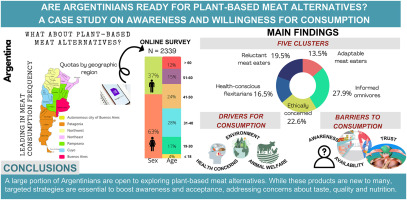
Specifically, this study aimed to i) identify the level of knowledge, attitudes, and perceptions concerning PBMAs, focusing on the differences between Argentinian consumer segments; ii) to examine demographic factors that influence the willingness to adopt PBMAs and, iii) to assess key barriers and motivations toward PBMAs consumption. By delving into this unexplored area, we intend to collaborate in the design of effective strategies for expanding these products in the region, providing valuable insights into the market landscape and growth opportunities within the country.