Palmaria palmata Bacon Market Forecast and Outlook 2025 to 2035
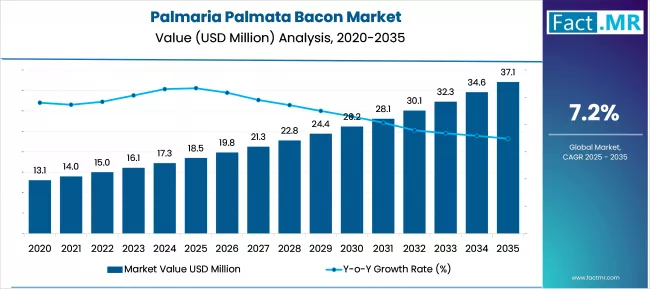
The global Palmaria palmata bacon market is projected to grow from USD 18.5 million in 2025 to approximately USD 37.1 million by 2035, recording an absolute increase of USD 20.0 million over the forecast period. This translates into a total growth of 108.1%, with the market forecast to expand at a compound annual growth rate (CAGR) of 7.2% between 2025 and 2035. The overall market size is expected to grow by nearly 2.08X during the same period, supported by increasing consumer demand for plant-based meat alternatives, rising awareness about sustainable food sources, and growing popularity of algae-based products in the culinary industry.
Quick Stats for Palmaria palmata Bacon Market
- Palmaria palmata Bacon Market Value (2025): USD 18.5 million
- Palmaria palmata Bacon Market Forecast Value (2035): USD 37.1 million
- Palmaria palmata Bacon Market Forecast CAGR: 7.2%
- Leading Product Type in Palmaria palmata Bacon Market: Fresh/Refrigerated (60%)
- Key Growth Regions in Palmaria palmata Bacon Market: North America, Europe, and Asia Pacific
- Top Key Players in Palmaria palmata Bacon Market: Ocean’s Harvest Ltd., SeaTaste Foods, North Sea Organics, Algae Delights, MarineBacon Inc.
Between 2025 and 2030, the Palmaria palmata bacon market is projected to expand from USD 18.5 million to USD 26.8 million, resulting in a value increase of USD 8.3 million, which represents 41.5% of the total forecast growth for the decade. This phase of growth will be shaped by rising consumer interest in vegan meat alternatives, increasing availability of sustainable food products, and growing penetration of specialty food retailers in emerging markets. Food manufacturers and specialty producers are expanding their algae-based product portfolios to address the growing demand for innovative plant-based protein solutions.
Palmaria palmata Bacon Market Key Takeaways
| Metric | Value |
|---|---|
| Estimated Value in (2025E) | USD 18.5 million |
| Forecast Value in (2035F) | USD 37.1 million |
| Forecast CAGR (2025 to 2035) | 7.2% |
From 2030 to 2035, the market is forecast to grow from USD 26.8 million to USD 37.1 million, adding another USD 11.7 million, which constitutes 58.5% of the overall ten-year expansion. This period is expected to be characterized by expansion of online retail channels, integration of advanced processing technologies, and development of new flavor profiles and product variations. The growing adoption of sustainable food trends and celebrity chef endorsements will drive demand for premium Palmaria palmata bacon products with enhanced taste profiles and nutritional benefits.
Between 2020 and 2025, the Palmaria palmata bacon market experienced steady growth, driven by increasing consumer awareness of plant-based alternatives and growing concern about environmental sustainability in food production. The market developed as food manufacturers recognized the potential of sea vegetables to replicate traditional meat flavors and textures. Social media influence and celebrity chef recommendations began highlighting the unique umami properties of Palmaria palmata in creating bacon-like experiences for health-conscious consumers.
Why the Palmaria palmata Bacon Market is Growing?
Market expansion is being supported by the increasing consumer shift toward plant-based diets and the corresponding demand for sustainable protein alternatives that mimic traditional meat products. Modern consumers are increasingly focused on reducing their environmental footprint while maintaining familiar flavors and textures in their food choices. Palmaria palmata’s natural umami properties and ability to crisp when cooked make it an ideal substitute for traditional bacon, appealing to vegans, vegetarians, and flexitarians alike.
The growing emphasis on ocean farming and sustainable aquaculture is driving interest in sea vegetables as renewable food sources that require minimal land use and fresh water resources. Consumer preference for minimally processed, whole-food alternatives to highly processed plant-based meats is creating opportunities for innovative seaweed-based products. The rising influence of sustainable food movements and environmental consciousness is also contributing to increased product adoption across health-conscious demographics and environmentally aware consumers.
Segmental Analysis
The market is segmented by product type, application, processing method, distribution channel, and region. By product type, the market is divided into fresh/refrigerated, frozen, vacuum packaged, and dried varieties. Based on application, the market is categorized into retail consumers, food service industry, and industrial food processing. In terms of processing method, the market is segmented into raw, pre-cooked, seasoned, and flavored variants. By distribution channel, the market is classified into specialty food stores, online retail, supermarkets/hypermarkets, and direct-to-consumer sales. Regionally, the market is divided into North America, Europe, Asia Pacific, Latin America, and Rest of World.
By Product Type, Fresh/Refrigerated Segment Accounts for 60% Market Share
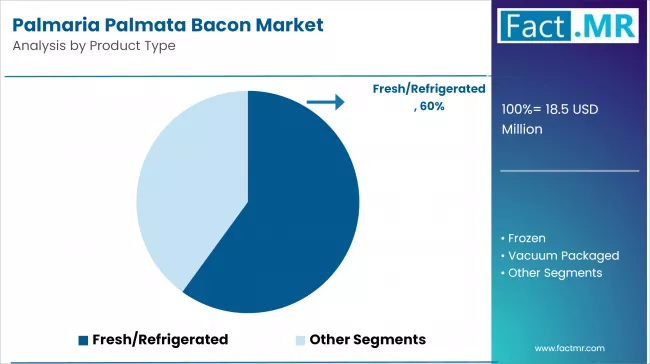
The fresh/refrigerated product type is projected to account for 60% of the Palmaria palmata bacon market in 2025, establishing its position as the preferred format for premium culinary applications. Consumers and chefs value the superior texture, flavor intensity, and cooking versatility that fresh Palmaria palmata provides compared to processed alternatives. The natural crispy texture achieved when pan-frying fresh sea lettuce closely mimics traditional bacon’s cooking experience, making it attractive to both professional kitchens and home cooks.
This segment benefits from the clean-label trend, as fresh products require minimal processing and preservatives, appealing to health-conscious consumers seeking natural alternatives. Premium restaurants and specialty food retailers are driving demand for fresh Palmaria palmata bacon due to its superior culinary performance and photogenic presentation. The segment’s dominance reflects consumer willingness to pay premium prices for fresh, high-quality sea vegetables that deliver authentic bacon-like experiences while maintaining nutritional integrity and environmental sustainability.
By Application, Retail Consumers Segment Accounts for 55% Market Share
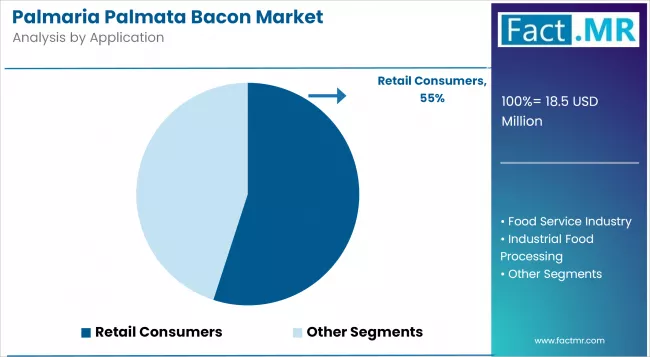
Retail consumers are projected to represent 55% of Palmaria palmata bacon demand in 2025, highlighting the growing home cooking trend and consumer interest in experimenting with innovative plant-based ingredients. Health-conscious households are increasingly incorporating sea vegetables into their regular meal planning, seeking alternatives that provide familiar flavors while supporting dietary and environmental goals. The segment benefits from growing awareness of Palmaria palmata’s nutritional benefits, including high mineral content, natural umami flavor, and low calorie profile.
Home cooks appreciate the ingredient’s versatility in breakfast dishes, salads, soups, and snacks, making it a valuable pantry staple for plant-based cooking. Social media recipe sharing and cooking show features are driving consumer confidence in preparing Palmaria palmata bacon at home. The retail segment’s growth is supported by increasing availability in specialty stores, natural food retailers, and online platforms, making these products more accessible to curious consumers seeking sustainable protein alternatives for regular consumption.
By Processing Method, Pre-cooked Segment Shows Strong Growth Potential
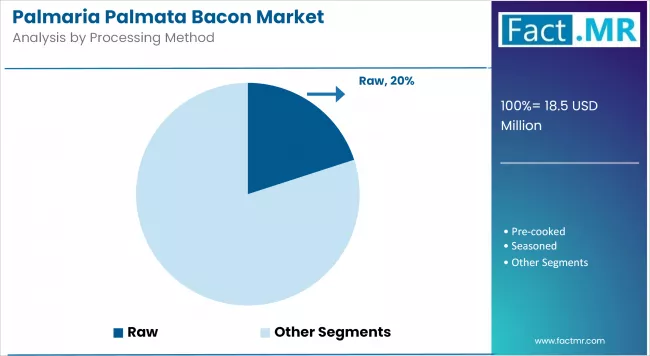
The pre-cooked processing method is gaining significant traction in the Palmaria palmata bacon market, driven by consumer demand for convenient, ready-to-eat alternatives that maintain the characteristic crispy texture and savory flavor profile. Pre-cooked products appeal to busy professionals, families, and food service operators who value consistent results and time-saving preparation methods. This segment benefits from advanced processing technologies that preserve nutritional content while extending shelf life and improving food safety standards.
Food manufacturers are investing in proprietary cooking and preservation techniques that deliver restaurant-quality results in convenient formats suitable for retail distribution. The pre-cooked segment enables broader market penetration by reducing preparation barriers and cooking uncertainty that might deter first-time users. Brand positioning emphasizes convenience without compromising taste or nutritional benefits, making pre-cooked Palmaria palmata bacon an attractive option for mainstream consumers transitioning to plant-based alternatives.
What are the Drivers, Restraints, and Key Trends of the Palmaria palmata Bacon Market?
The Palmaria palmata bacon market is advancing rapidly due to increasing environmental consciousness among consumers and growing demand for sustainable protein alternatives. However, the market faces challenges including limited cultivation capacity, seasonal availability constraints, and consumer unfamiliarity with sea vegetable preparation methods. Innovation in aquaculture techniques and product development continues to influence market expansion and accessibility patterns.
Growth of Ocean Farming and Sustainable Aquaculture Practices
The expansion of ocean farming operations is enabling increased production of high-quality Palmaria palmata for food applications. Sustainable seaweed cultivation requires no fresh water, arable land, or fertilizers, making it an environmentally attractive protein source. Advanced aquaculture techniques are improving yield consistency and product quality while reducing harvesting costs and environmental impact. Ocean farming initiatives supported by environmental organizations and government incentives are creating new supply sources for food manufacturers.
Rising Celebrity Chef Endorsements and Culinary Innovation
Prominent chefs and culinary influencers are incorporating Palmaria palmata bacon into high-profile recipes and restaurant menus, driving consumer awareness and acceptance. Cooking shows, food magazines, and social media platforms are featuring creative applications that demonstrate the ingredient’s versatility and flavor potential. Professional culinary training programs are including sea vegetable preparation techniques, building expertise among food service professionals and enhancing market credibility.
Development of Enhanced Flavor Profiles and Product Varieties
Food manufacturers are developing seasoned and flavored variants of Palmaria palmata bacon to appeal to diverse taste preferences and culinary applications. Innovation in natural flavoring techniques is creating products that closely mimic traditional bacon taste profiles while maintaining clean-label credentials. Product line extensions include smoked varieties, spiced blends, and regional flavor adaptations that broaden market appeal and usage occasions.
Palmaria palmata Bacon Market by Key Country
Europe Market Split by Country
The European Palmaria palmata bacon market demonstrates sophisticated development through sustainable food sourcing, culinary innovation, and premium positioning across diverse consumer segments seeking environmentally conscious protein alternatives. United Kingdom leads market development through strong environmental consciousness, celebrity chef advocacy, and increasing integration into high-end restaurant menus while emphasizing sustainable food alternatives aligned with environmental values.
Germany maintains growth leadership in organic food market consumption, environmental awareness, and established natural food retail infrastructure supporting sustainably sourced products throughout extensive organic food retail networks. France strengthens market position through sophisticated food culture, culinary excellence, and growing interest in sustainable gastronomy with high-end restaurants incorporating Palmaria palmata into seasonal menus and artisanal offerings. European consumers consistently prioritize organic certification, terroir-based foods, local sourcing development, and premium ingredient positioning. The region emphasizes advanced processing methods, flavor enhancement technologies, and product formulations supporting market credibility and consumer acceptance across metropolitan areas.
Japan Market Split by Country
The Japanese Palmaria palmata bacon market demonstrates strong growth potential through traditional sea vegetable consumption knowledge, advanced food processing technologies, and increasing health consciousness among diverse consumer demographics seeking nutrient-dense protein alternatives. Japanese manufacturers leverage established seaweed industry expertise in cultivation, processing, and marketing while combining traditional preparation knowledge with modern food technology creating innovative product formulations appealing to domestic and international markets.
The market benefits from traditional dietary patterns, comprehensive sea vegetable consumption acceptance, and sophisticated understanding of marine ingredient nutritional benefits supporting sustained product adoption. Growing health-focused consumer trends and aging population demographics drive demand for low-calorie, nutrient-dense alternatives supporting wellness goals and dietary preferences. Japanese companies emphasize quality control systems, processing precision, and specialized formulations while integrating sustainable cultivation practices with advanced preservation technologies. Traditional knowledge combined with modern innovation creates opportunities for premium positioning and export market development across health-conscious consumer segments requiring superior nutritional profiles.
South Korea Market Split by Country
The South Korean Palmaria palmata bacon market shows emerging growth potential driven by expanding plant-based food movement, increasing environmental consciousness, and growing consumer interest in sustainable protein alternatives providing familiar flavor experiences. Korean consumers demonstrate receptiveness to innovative seaweed applications while valuing traditional marine ingredient knowledge and modern convenience food solutions. The market benefits from established seafood consumption culture, advanced food processing capabilities, and growing health awareness supporting adoption of nutrient-dense alternatives across diverse consumer segments. Rising interest in clean-label products, sustainable sourcing practices, and environmentally responsible food choices creates opportunities for premium Palmaria palmata bacon positioning.
Korean food manufacturers emphasize product innovation, flavor enhancement techniques, and convenient preparation methods while maintaining nutritional integrity and environmental sustainability credentials. Integration with modern Korean food culture and expanding retail distribution channels supports market development across health-conscious demographics seeking familiar taste profiles with enhanced environmental benefits and nutritional advantages throughout diverse culinary applications.
Analysis of Palmaria palmata Bacon Market
| Country | CAGR (2025-2035) |
|---|---|
| Canada | 9.0% |
| USA | 8.5% |
| UK | 7.8% |
| Germany | 7.5% |
| France | 7.0% |
| Japan | 6.8% |
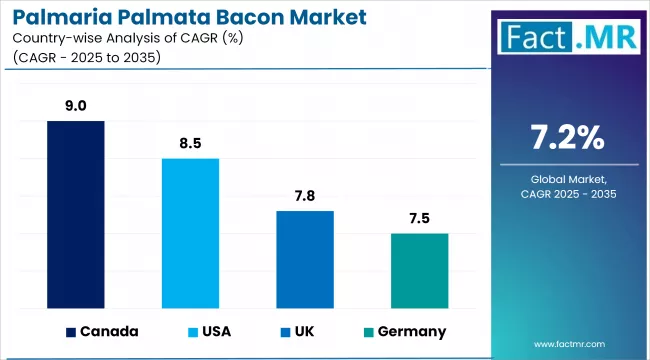
The Palmaria palmata bacon market is experiencing robust growth globally, with Canada leading at a 9.0% CAGR through 2035, driven by abundant natural resources, government support for ocean farming, and strong environmental consciousness among consumers. The USA follows closely at 8.5%, supported by the massive plant-based food market, innovative food companies, and growing mainstream acceptance of alternative proteins. The UK shows strong growth at 7.8%, focusing on sustainable food sourcing and celebrity chef endorsements. Germany records 7.5% growth, prioritizing organic and natural food products. France demonstrates 7.0% expansion, driven by culinary innovation and gourmet food culture.
The report covers an in-depth analysis of 25+ countries; six top-performing countries are highlighted below.
Canada Leads Market Growth with Sustainable Ocean Farming Innovation
Revenue from Palmaria palmata bacon in Canada is projected to exhibit exceptional growth with a CAGR of 9.0% through 2035, driven by the country’s extensive Atlantic coastline, established seaweed harvesting traditions, and government support for sustainable aquaculture development. Canada’s maritime provinces possess ideal growing conditions and existing infrastructure for commercial Palmaria palmata cultivation, creating natural competitive advantages in production costs and product quality.
- Government initiatives supporting ocean farming development and indigenous food sovereignty are driving investment in sustainable seaweed cultivation throughout Atlantic coastal regions.
- Growing consumer awareness of local, sustainable food sources is creating strong domestic demand while export opportunities expand to international markets seeking premium sea vegetables.
United States Demonstrates Strong Market Adoption with Plant-Based Food Integration
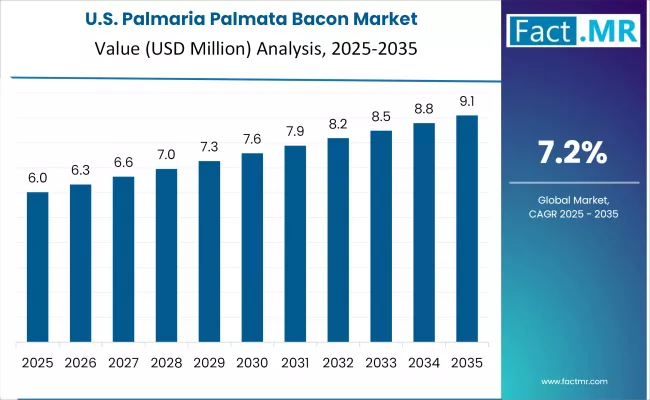
Revenue from Palmaria palmata bacon in the United States is expanding at a CAGR of 8.5%, supported by the massive plant-based food market, innovative food technology companies, and increasing mainstream consumer acceptance of alternative proteins. The country’s diverse food retail landscape and strong food service industry provide extensive distribution opportunities for Palmaria palmata bacon products across multiple market segments.
- Major plant-based food manufacturers are incorporating Palmaria palmata into product formulations, while specialty food retailers are expanding sea vegetable selections to meet growing consumer demand.
- Celebrity chef endorsements and social media influence are driving product awareness and trial among health-conscious consumers seeking sustainable protein alternatives with familiar flavors.
United Kingdom Focuses on Sustainable Food Sourcing and Culinary Innovation
Demand for Palmaria palmata bacon in the UK is projected to grow at a CAGR of 7.8%, supported by strong environmental consciousness, celebrity chef advocacy, and increasing integration into high-end restaurant menus. British consumers are particularly receptive to sustainable food alternatives that align with environmental values while providing familiar taste experiences.
- Growing emphasis on reducing food miles and supporting local food systems is creating opportunities for domestic Palmaria palmata cultivation and processing operations.
- Premium food retailers and organic stores are expanding sea vegetable offerings, while food media coverage is increasing consumer awareness of culinary applications and nutritional benefits.
Germany Maintains Growth with Organic Food Market Leadership
Revenue from Palmaria palmata bacon in Germany is projected to grow at a CAGR of 7.5% through 2035, driven by the country’s leadership in organic food consumption, strong environmental awareness, and established natural food retail infrastructure. German consumers consistently prioritize organic, sustainably sourced products, making Palmaria palmata bacon an attractive addition to existing plant-based protein options.
- Extensive organic food retail networks and biodynamic farming principles are supporting market adoption of sustainably harvested sea vegetables throughout major metropolitan areas.
- Research institutions and food technology companies are collaborating to develop improved processing methods and product formulations that enhance flavor profiles and shelf stability.
France Strengthens Market with Gourmet Food Culture and Culinary Excellence
Revenue from Palmaria palmata bacon in France is projected to grow at a CAGR of 7.0% through 2035, supported by the country’s sophisticated food culture, culinary innovation, and growing interest in sustainable gastronomy. French consumers value artisanal quality and unique flavor experiences, positioning Palmaria palmata bacon as a premium ingredient for gourmet applications.
- High-end restaurants and specialty food stores are incorporating Palmaria palmata into seasonal menus and artisanal product offerings, building market credibility and consumer acceptance.
- Growing movement toward terroir-based foods and local sourcing is encouraging development of French coastal Palmaria palmata cultivation and processing operations.
Japan Anchors Growth with Traditional Sea Vegetable Knowledge and Modern Innovation
Revenue from Palmaria palmata bacon in Japan is projected to grow at a CAGR of 6.8% through 2035, supported by traditional sea vegetable consumption patterns, advanced food processing technologies, and increasing health consciousness among consumers. Japan’s established seaweed industry provides expertise in cultivation, processing, and marketing that benefits Palmaria palmata bacon development.
- Traditional knowledge of sea vegetable preparation combined with modern food technology is creating innovative product formulations that appeal to both domestic and international markets.
- Health-focused consumer trends and aging population demographics are driving demand for nutrient-dense, low-calorie protein alternatives that support wellness goals and dietary preferences.
Competitive Landscape of Palmaria palmata Bacon Market
The Palmaria palmata bacon market is characterized by competition among specialty sea vegetable producers, plant-based food companies, and innovative startups focused on sustainable protein alternatives. Companies are investing in sustainable cultivation practices, advanced processing technologies, premium packaging solutions, and direct-to-consumer marketing strategies to deliver high-quality, accessible, and appealing sea vegetable products. Brand positioning, product innovation, and supply chain sustainability are central to building market presence and consumer loyalty.
Ocean’s Harvest Ltd., Canada-based, leads the market with superior product quality and sustainable harvesting practices focused on premium culinary applications. SeaTaste Foods provides consistent supply chain management and product standardization with emphasis on food service distribution. North Sea Organics delivers certified organic Palmaria palmata products with focus on retail consumer markets and online sales channels. Algae Delights specializes in innovative processing methods that enhance flavor profiles and extend shelf life.
MarineBacon Inc. focuses on developing bacon-specific formulations and cooking instructions that maximize consumer success and satisfaction. Emerging companies are exploring value-added products including seasoned varieties, prepared foods, and ingredient supply for food manufacturers. The competitive landscape emphasizes sustainable sourcing, product quality, and consumer education as key differentiators in building brand loyalty and market share.
Key Players in the Palmaria palmata Bacon Market
- Ocean’s Harvest Ltd.
- SeaTaste Foods
- North Sea Organics
- Algae Delights
- MarineBacon Inc.
- Atlantic Sea Farms
- Maine Coast Sea Vegetables
- Pacific Harvest
- Seaweed & Co.
- Wild Atlantic Way Seaweed
Scope of the Report
| Items | Values |
|---|---|
| Quantitative Units (2025) | USD 18.5 Million |
| Product Type | Fresh/refrigerated, Frozen, Vacuum packaged, Dried |
| Application | Retail consumers, Food service industry, Industrial food processing |
| Processing Method | Raw, Pre-cooked, Seasoned, Flavored |
| Distribution Channel | Specialty food stores, Online retail, Supermarkets/hypermarkets, Direct-to-consumer |
| Packaging Type | Bulk, Retail packages, Food service portions, Individual servings |
| Regions Covered | North America, Europe, Asia Pacific, Latin America, Rest of World |
| Countries Covered | United States, Canada, United Kingdom, Germany, France, Japan, South Korea, Australia, Norway, Iceland and 15+ countries |
| Key Companies Profiled | Ocean’s Harvest Ltd., SeaTaste Foods, North Sea Organics, Algae Delights, MarineBacon Inc., Atlantic Sea Farms, Maine Coast Sea Vegetables, Pacific Harvest, Seaweed & Co., and Wild Atlantic Way Seaweed |
| Additional Attributes | Dollar sales by product format and processing level, regional cultivation trends, competitive landscape, consumer preferences for organic versus conventional products, integration with sustainable food positioning, innovations in flavor enhancement, preservation technologies, and ocean farming practices |
Palmaria palmata Bacon Market by Segments
-
Product Type :
- Fresh/refrigerated
- Frozen
- Vacuum packaged
- Dried
-
Application :
- Retail consumers
- Food service industry
- Industrial food processing
-
Processing Method :
- Raw
- Pre-cooked
- Seasoned
- Flavored
-
Distribution Channel :
- Specialty food stores
- Online retail
- Supermarkets/hypermarkets
- Direct-to-consumer
-
Packaging Type :
- Bulk
- Retail packages
- Food service portions
- Individual servings
-
Region :
- North America
- United States
- Canada
- Mexico
- Europe
- Germany
- United Kingdom
- France
- Italy
- Spain
- Nordic Countries
- Rest of Europe
- Asia Pacific
- Japan
- South Korea
- Australia
- New Zealand
- Rest of Asia Pacific
- Latin America
- Brazil
- Chile
- Rest of Latin America
- Rest of World
- Middle East
- Africa
- Other Regions
- North America