Plant-Based Meat Market Size, Share, and Growth 2025-2035 | Amy’s Kitchen, Beyond Meat, Conagra Brands (Gardein), and More
Global Plant-Based Meat Market:
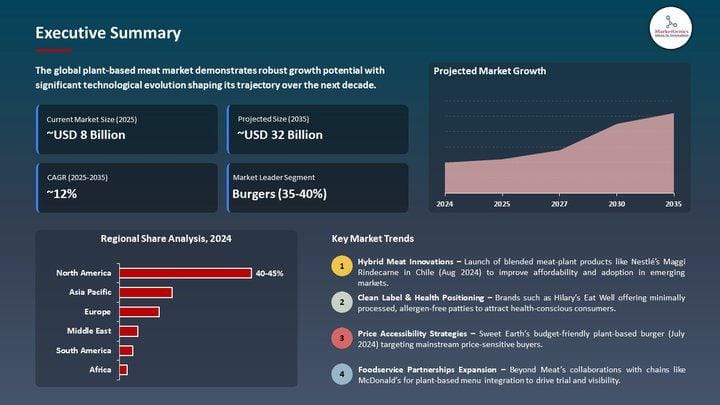
According to the report, the global plant-based meat market is likely to grow from USD 8.9 billion in 2024 to USD 32.8 billion in 2035 at a moderate CAGR of 12.6% during the time period. On the verge of strong growth is afforded by the plant-based meat market due to the alloying forces of health, environment, and innovation. Increasing awareness of lifestyle diseases such as obesity, heart diseases, and diabetes has motivated consumers onto a healthier track of alternative proteins where plant-based meats come with a profile of low cholesterol and saturated fats.
The advancement in technology brought improvements in food processing, including that in shear-cell and high-moisture extrusion, thus allowing a better replication of meat textures toward higher consumer acceptability. Yet another concern is the carbon footprint and water usage of livestock farming, which have brought individuals as well as institutions to select the sustainable alternative.
Get the Detailed Industry Analysis (including the Table of Contents, List of Figures, and List of Tables) – from the Plant-Based Meat Market Research Report: https://marketgenics.co/press-releases/plant-based-meat-market-74029
Governments and regulatory bodies in some parts of Europe and North America are also rolling out incentives and subsidies for plant-based innovations; for instance, increased funding was announced by the EU in 2024 for plant-based food research under the Horizon Europe program. All the above, coupled with growth in the diversity of products and accessibility in retail, pave paths toward mass acceptance and growth in the global market.
“Key Driver, Restraint, and Growth Opportunity Shaping the Global Plant-Based Meat Market
Before, fast food and QSR sales worldwide must have been considered the most significant contributors to the plant-based meat market. Chains such as Burger King, Starbucks and McDonald’s are adding plant-based products to their menus, bringing attention to the evolving consumer concern of sustainability and healthy living.
At the beginning of 2024, after an ultratrial phase in co-operation with Beyond Meat, McDonald’s Germany launched McPlant Nuggets as a core menu item.
In 2024, the Indian startup GoodDot ventured into Kenya and South Africa with ready-to-eat plant-based meats containing local ingredients and local relevance. Such a regional expansion bestows a double boon: one meeting nutritional needs and the other being a foster of sustainable food systems in fast-growing economies. These associations give visibility to and mainstream plant-based options and in turn create demand, particularly among flexitarians searching for easy meat alternatives in common dining settings.
Taste and texture, though ameliorated somewhat, remain as another major constraint. Many consumers, especially those traditionally eating animal meat, maintain that plant-based meats do not quite stack up when it comes to flavor, mouthfeel, or juiciness against real animal meat. This perception negates repeat purchase and long-term acceptance. With extrusion and fermentation innovation making progress, though, it remains a big challenge for brands to keep closing the sensory gap in converting doubters. Until parity is obtained, especially for products such as steaks or whole cuts, consumer conversion outside of those health-conscious or eco-aware segments is minimal.
Emerging markets such as Southeast Asia, Latin America, and some parts of Africa, where meat consumption is rising due to urbanization and income growth, present an untapped opportunity. Plant-based alternatives could be brought to market at a competitive price, limiting protein demand from further environmental degradation.
In 2024, the Indian startup GoodDot ventured into Kenya and South Africa with ready-to-eat plant-based meats containing local ingredients and local relevance. Such a regional expansion bestows a double boon: one meeting nutritional needs and the other being a foster of sustainable food systems in fast-growing economies.
To know more about the Plant-Based Meat Market – Download our Sample Report: https://marketgenics.co/download-report-sample/plant-based-meat-market-74029
“Impact of Global Tariff Policies on the Plant-Based Meat Market Growth and Strategy”
Tariff rates largely determine the global plant-based meat market, thus having pricing implications for imported goods on a cost-plus basis. When import tariffs are levied either upon plant-based meat products or upon their prominent raw materials such as soy protein, pea protein, or wheat gluten, foreign brands find it tough to enter into price-sensitive markets. For example, with India imposing very high tariffs in case of processed foods including meat substitutes, it becomes extremely difficult for international plant-based brands like Beyond Meat to compete on prices vis-à-vis local plant-based product alternatives. These price barriers decrease the accessibility of plant-based foods and also negate their prospects of attaining mass adoption in developing economies.
Reduced tariffs, on the other hand, serve rapid market expansion and speeded-up scaling of multinational brands in newly accessed territories. So far, the most promising example is found in the 2023 EU-Singapore Free Trade Agreement, where tariffs were eliminated on plant-based food imports including meat substitutes-with increased market penetration of European producers such as The Vegetarian Butcher (Unilever) in Southeast Asia being one result. In this way, low tariffs foster international trade, promote the sharing of innovations, and give consumers access to high-quality international plant-based meat products, putting a rapid growth spurt into the market at large.
Expansion of Global Plant-Based Meat Market
“Key Expansion Factors Driving Growth of the Global Plant-Based Meat”
With an increasing health consciousness among consumers and rising inquiries for environmentally sustainable food sources, the global plant-based meat market is currently growing at a rapid pace. According to the Good Food Institute, retail sales of plant-based meat products crossed $1.4 billion in the U.S. alone in 2023, which shows that many consumers are concerned about cholesterol problems, heart problems, antibiotic use in traditional meat, and so on. Manufacturers are then led to address this mindset by providing newer protein-rich and low-fat options. For instance, in March 2024, Nestlé decided to further extend its Garden Gourmet brand in Europe, citing an observed high demand for flexitarian health lifestyles.
Increasing investments and R&D by international food giants propel innovations, which put together accessibility opportunities, thus promoting market growth. JBS, which is one of the biggest meat processors in the world, in January 2024, declared a $40-million investment in its plant-based subsidiary Planterra Foods for ramping up production capacity and diversifying product offerings in Latin America and North America. These investments allow an enhancement in volume of manufacturing and other things keeping in mind cost optimization while ensuring an extended product range, which attracts a wider consumer market.
Government initiatives and policies favoring the environment further catalyze market growth. According to a late 2023 update, the Chinese government has added plant-based proteins to the domain of national food security, thus encouraging the domestic enterprises like Zhenmeat and Starfield to innovate meat substitutes suited to local preferences. The EU Horizon program similarly examines and funds alternative protein research, so cementing Europe’s position as a growth hub. These enablers are indispensable for regional and global growth.
Regional Analysis of Global Plant-Based Meat Market
Demand for plant-based meat is highest in North America, where food innovation is considered part of culture among early adopters, a large and stable buyer base of vegans and vegetarians exists, and branding has already been personified. In recent years, big fast-food chains started selling plant-based versions of their meals, including the Impossible Whopper and McPlant, to mirror evolving tastes of the customers and promote them as well. According to PLANT BASED FOODS ASSOCIATION stats of 2023, approximately 66% of U.S. households purchased plant-based foods that year. There is, indeed, a demand from millennial and Gen Z segments, which factor health, ethical issues, and sustainability into their support for meat substitutes. Retail gargantuas like Kroger and Whole Foods have expanded shelf space allotment toward plant-based products, consequently pushing the consumption into a mainstream.
Plant-based products are enjoying the best boom in Asia and the Pacific, promoted by growing disposable incomes, further urbanization, and rising awareness regarding zoonotic diseases. Countries like China and India where populations go up to billions and an underlying traditional inclination toward plant-based dietary patterns are now increasingly focusing on the meat alternatives of the Western kind. For instance, in April 2024, India-based Blue Tribe Foods added plant-based chicken nuggets and sausages to its portfolio with strong retail support from chains like Nature’s Basket. Moreover, in view of their food safety and diversification away from protein focus, countries like Singapore and South Korea are promoting government grants in cellular and plant-based protein R&D. The fastest growing market for meat alternatives is in the region because of its dynamic food-tech start-up ecosystem and changing consumer behavior.
Prominent players operating in the global plant-based meat market are Amy’s Kitchen, Beyond Meat, Conagra Brands (Gardein), Eat Just, Inc., Gold&Green Foods (part of Paulig Group), Hilary’s Eat Well, Impossible Foods, Kellogg Company (MorningStar Farms), Lightlife Foods, Maple Leaf Foods (Greenleaf Foods), Moving Mountains, Nestlé (Sweet Earth Foods, Garden Gourmet), Planterra Foods (OZO), Quorn Foods, Sunfed Meats, The Kraft Heinz Company (BOCA Foods), Tofurky Co., Tyson Foods (Raised & Rooted), Unilever (The Vegetarian Butcher), VBites Foods and Other Key Players.
Buy Now: https://marketgenics.co/buy/plant-based-meat-market-74029
The global Plant-Based Meat market has been segmented as follows:
Global Plant-Based Meat Market Analysis, by Product Type
Burgers
Sausages
Nuggets & Strips
Ground Meat
Meatballs
Deli Slices
Seafood Analogues
Others (Bacon, Hot Dogs, Jerky, etc.)
Global Plant-Based Meat Market Analysis, by Source
Soy
Pea
Wheat
Mycoprotein
Rice & Potato
Algae & Seaweed
Other Plant Sources (Beans, Lentils, Beetroot, Chickpeas)
Global Plant-Based Meat Market Analysis, by Fat Content
Low-Fat Products
High-Protein Formulations
Fortified with Vitamins & Minerals (e.g., B12, Iron, Omega-3)
Global Plant-Based Meat Market Analysis, by End-users
Household/Individual Consumers
Flexitarians
Vegans and Vegetarians
Health-Conscious Consumers
Others
Foodservice Industry
Quick-Service Restaurants (QSRs)
Full-Service Restaurants
Cafes & Bistros
Others
Institutional Consumers
Industrial & Private Label Manufacturers
Frozen Meal Manufacturers
Canned/Packaged Food Companies
Others
Other End-users
Global Plant-Based Meat Market Analysis, by Distribution Channel
Supermarkets & Hypermarkets
Specialty Stores (Organic/Natural Food Stores)
Convenience Stores
Online Retail/E-commerce
Meal Kit Services & Subscription Boxes
Others
Global Plant-Based Meat Market Analysis, by Packaging Type
Vacuum Packs
Modified Atmosphere Packaging (MAP)
Tray Sealing
Sustainable & Biodegradable Packaging
Others
Global Plant-Based Meat Market Analysis, by Shelf Life
Short Shelf Life (30 days)
Global Plant-Based Meat Market Analysis, by Price Tier
Premium
Mid-range
Budget
Global Plant-Based Meat Market Analysis, by Region
North America
Europe
Asia Pacific
Middle East
Africa
South America
About Us
MarketGenics is a global market research and management consulting company empowering decision makers across healthcare, technology, and policy domains. Our mission is to deliver granular market intelligence combined with strategic foresight to accelerate sustainable growth.
We support clients across strategy development, product innovation, healthcare infrastructure, and digital transformation.
Contact:
Mr. Debashish Roy
MarketGenics India Pvt. Ltd.
800 N King Street, Suite 304 #4208, Wilmington, DE 19801, United States
USA: +1 (302) 303-2617
Email: [email protected]
Website: https://marketgenics.co
This release was published on openPR.