The rapid growth of the global population has led to a substantial increase in food demand, particularly for meat, which is valued for its high protein content and essential amino acids critical to human nutrition. However, the rapid expansion of the livestock industry has posed severe challenges to land use, water resources, and the environment environmental sustainability (Crippa et al., 2021). Simultaneously, with improving living standards and growing health consciousness, there is a rising demand to reduce animal meat intake and adopt more environmentally friendly and health-conscious high-quality protein alternatives (Salter, 2018). In response to meet these challenges and shifting consumer needs, the search for plant-based meat substitutes has emerged as a key focus of global interest become the focus of global attention.
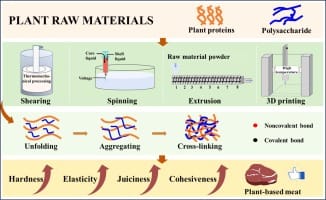
Plant-based meat substitutes are made from plant-derived proteins, polysaccharides, and other essential components (Fig. 1), and are designed to mimic the sensory and qualitative properties of animal meats. Among these, texture characterized by properties such as hardness, elasticity, juiciness and cohesiveness is pivotal for consumer acceptance, as it significantly affects both the taste and overall eating experience (Bakhsh et al., 2021, Pointke et al., 2022). The latest trends in the development of plant-based meat substitutes are outlined in Fig. 2. Despite considerable progress in enhancing flavor and nutritional profiles, achieving a texture comparable to traditional meat remains a significant challenge (Shankaran & Kumari, 2024). The unique texture of meat primarily stems from the fiber structure and fat distribution of animal muscle, whereas plant-based products need to rely on protein-polysaccharide interactions and advanced processing techniques to recreate a similar sensory experience.
Proteins and polysaccharides are the key components in the formation of food structure. The interaction between them has a decisive influence on the texture, stability and sensory characteristics of food (Wang et al., 2024, Wang et al., 2024). In plant-based meat products, proteins are responsible for providing structural support and elasticity, while polysaccharides affect the hydration and elasticity of the product. The interactions between proteins and polysaccharides, including the formation of covalent and non-covalent bonds, can affect the texture of the final product by changing the molecular structure and arrangement of proteins and polysaccharides (Doublier et al., 2000). Processing technology plays a crucial role in determining the texture of plant-based meat products. In recent years, researchers have effectively improved the texture and sensory characteristics of plant meat by optimizing the selection and combination of various plant proteins and polysaccharides, alongside employing advanced processing technologies such as spinning, extrusion, shearing, and 3D printing (Table 1). Therefore, an in-depth understanding of these interactions and their effects on the texture of plant-based meat products is essential for developing plant-based meat products with better taste and acceptability.
Despite notable progress in the development of plant-based meat products, particularly in diversifying new offerings, research on the specific mechanism by which protein-polysaccharide interactions enhance the texture of plant-based meat remains limited. This review aims to bridge this gap by analyzing of the critical roles of protein-polysaccharide interactions and processing technologies in optimizing textural attributes. By providing a scientific foundation, this work seeks to support the development and refinement of plant-based meat products, aligning with market demand for high-quality alternatives to traditional meat.