Introduction: Accelerating Shift Toward Sustainable and Protein-Rich Food Alternatives
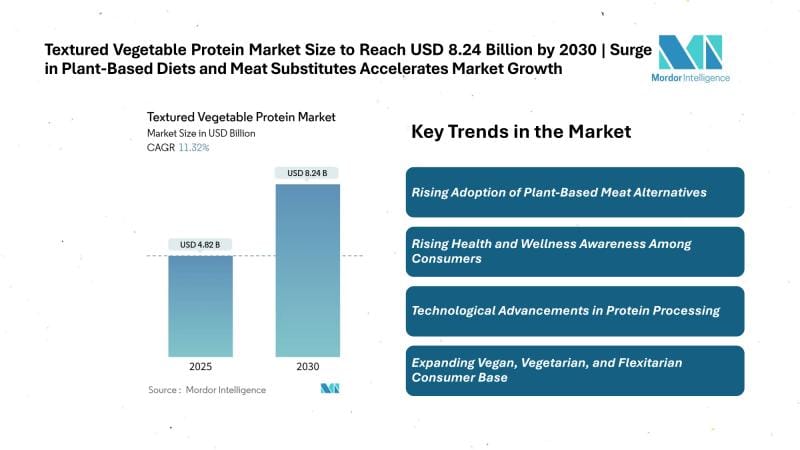
The global textured vegetable protein (TVP) market is poised for significant expansion, estimated at USD 4.82 billion in 2025 and projected to reach USD 8.24 billion by 2030, registering a robust CAGR of 11.32% during the forecast period. The market’s strong performance is driven by the rising demand for plant-based proteins, sustainable food sources, and consumer preference for healthier meat substitutes.
According to the latest textured vegetable protein market report, several macro factors-such as the global rise of veganism, cost-efficient protein sourcing, and advanced extrusion technologies-are fueling growth. Governments and regulatory authorities, including the U.S. Food and Drug Administration (FDA), are introducing clearer labeling standards for plant-based products, enhancing consumer trust and transparency.
Furthermore, breakthroughs in high-moisture extrusion (HME) and fermentation-based flavor enhancement have enabled manufacturers to replicate the fibrous, juicy structure of real meat. This innovation has expanded the adoption of textured vegetable protein across processed foods, meat analogues, and ready-to-eat (RTE) meals.
The growing flexitarian and health-conscious population across Asia-Pacific, North America, and Europe is redefining consumption patterns. According to industry analysis, innovations in processing and germination have elevated the sensory appeal, nutritional quality, and digestibility of TVP, further boosting its acceptance among global consumers.
Access the complete data-driven outlook on the textured vegetable protein market now – https://www.mordorintelligence.com/industry-reports/textured-vegetable-protein-market?utm_source_openpr
Key Trends: Technology, Health Awareness, and Consumer Shifts Drive Market Momentum
1. Rising Adoption of Plant-Based Meat Alternatives
The textured vegetable protein market growth is closely tied to the expansion of the plant-based meat industry. Consumers are actively seeking substitutes that mimic traditional meat in flavor, texture, and nutrition-without compromising on ethics or sustainability. Food manufacturers are leveraging optimized TVP formulations to develop burgers, sausages, nuggets, and crumbles with superior taste and texture.
Advancements in fermentation techniques are removing undesirable flavors and enhancing the sensory profile of plant-based proteins. This progress has paved the way for premium TVP-based meat analogues in markets such as the U.S., Germany, and the U.K., where vegan and flexitarian lifestyles have gone mainstream.
2. Rising Health and Wellness Awareness Among Consumers
The global TVP market benefits from shifting dietary habits and rising health consciousness. Consumers are gravitating toward foods high in plant proteins and low in cholesterol, fat, and additives. Textured vegetable protein offers a high-protein, low-calorie alternative to red and processed meats, aligning perfectly with these health-driven preferences.
Brands like Ingredion and Cargill are developing innovative pea- and soy-based TVP formulations for snacks, bakery, and sports nutrition. These new formulations enhance texture and flavor while supporting nutritional enrichment in diverse food applications.
3. Technological Advancements in Protein Processing
Innovation remains a key catalyst in the textured vegetable protein market growth. Modern twin-screw extrusion and low-moisture extrusion technologies are enhancing the ability to produce shelf-stable, fibrous TVP with superior texture retention.
Additionally, new processes like supercritical CO2 extrusion are improving protein quality, nutrient preservation, and overall product consistency. Leading food technology providers such as GEA Group are expanding global R&D centers to support large-scale production and sustainable food innovation.
4. Expanding Vegan, Vegetarian, and Flexitarian Consumer Base
Demographic and cultural shifts are reshaping the global protein landscape. Millennials and Gen Z consumers are championing sustainable and ethical food choices, driving strong demand for plant-based proteins.
In India and Southeast Asia, vegetarianism and religious dietary preferences are further accelerating consumption. Meanwhile, in Western regions, hybrid protein products-combining plant-based and animal-based ingredients-are emerging as transitional solutions for flexitarian consumers.
Moreover, the introduction of halal-certified TVP is creating new opportunities in the Middle East and Muslim-majority countries, widening the consumer base for plant protein producers.
Read the full report and access market snapshots that include both global views and Japan-specific analysis – https://www.mordorintelligence.com/ja/industry-reports/textured-vegetable-protein-market?utm_source_openpr
Market Segmentation: Type, Form, and End-User Insights
By Type
– Soy-based
– Wheat-based
– Pea-based
– Other Pulses (Faba, Lentil, Chickpea)
By Form
– Flakes
– Chunks
– Others
By End User
– Retail
– Foodservice
– Food and Feed Processing
– Meat Analogues
– Ready Meals and Snacks
– Bakery and Confectionery
– Animal and Aqua Feed
By Geography
– North America
– South America
– Europe
– Asia-Pacific
– Middle East and Africa
Competitive Landscape: Leading Companies Drive Expansion Through Innovation
The global textured vegetable protein market is moderately fragmented, featuring key players such as Cargill Inc., Archer Daniels Midland (ADM), Bunge Limited, Ingredion Incorporated, and Roquette Frères. These companies are focusing on innovation, capacity expansion, and sustainable production.
Strategic partnerships and mergers are helping leading brands strengthen their technological capabilities. For example, Roquette’s NUTRALYS® line and DSM-Firmenich’s collaboration with Meala exemplify the industry’s focus on enhancing product flavor, nutrition, and texture.
In addition, investments in extrusion facilities, flavor optimization, and clean-label formulations are enabling brands to align with evolving consumer expectations and sustainability targets.
Conclusion: Textured Vegetable Protein Poised for Sustained Global Growth
The textured vegetable protein market outlook remains highly positive, underpinned by strong consumer demand for sustainable, protein-rich, and affordable meat alternatives. Continuous innovation in food processing, along with favorable government initiatives, is expected to accelerate adoption across the global food and beverage sector.
While challenges such as taste optimization and labeling complexities persist, ongoing advancements in ingredient technology and product formulation are rapidly overcoming these barriers.
The global textured vegetable protein market forecast indicates that, as consumers increasingly choose plant-based options for health and environmental reasons, TVP will remain at the forefront of the plant protein revolution, shaping the future of sustainable nutrition worldwide.
Our Trending Reports
Europe Textured Vegetable Protein Market – The Europe Textured Vegetable Protein Market Report is Segmented by Type (Soy-Based, Wheat-Based, Pea-Based, Other Pulses), Form (Flakes, Chunks, Others), End User (Retail, Foodservice, Food and Feed Processing), and Geography (United Kingdom, Germany, France, Italy, Spain, Russia, Sweden, Belgium, Poland, Netherlands, Rest of Europe). The Market Forecasts are Provided in Terms of Value (USD) and Volume (Tons).
Get More Insights: https://www.mordorintelligence.com/industry-reports/europe-textured-vegetable-protein-market?utm_source_openpr
North America Textured Vegetable Protein Market – The North America Textured Vegetable Protein Market Report is Segmented by Type (Soy-Based, Wheat-Based, Pea-Based, Other Pulses), Form (Flakes, Chunks, Others), End User (Retail, Foodservice, Food and Feed Processing), and Geography (United States, Canada, Mexico, Rest of North America). The Market Forecasts are Provided in Terms of Value (USD) and Volume (Tons).
Get More Insights: https://www.mordorintelligence.com/industry-reports/north-america-textured-vegetable-protein-market?utm_source_openpr
United States Textured Vegetable Protein Market – The United States Textured Vegetable Protein Market Report is Segmented by Source (Soy-Based, Wheat-Based, Pea-Based, Other Pulses), Form (Flakes, Chunks, Others), End User (Retail, Foodservice, Food and Feed Processing), and Geography (United States). The Market Forecasts are Provided in Terms of Value (USD) and Volume (Tons).
Get More Insights: https://www.mordorintelligence.com/industry-reports/united-states-textured-vegetable-protein-market?utm_source_openpr
For any inquiries or to access the full report, please contact:
[email protected]
https://www.mordorintelligence.com/
About Mordor Intelligence:
Mordor Intelligence is a trusted partner for businesses seeking comprehensive and actionable market intelligence. Our global reach, expert team, and tailored solutions empower organizations and individuals to make informed decisions, navigate complex markets, and achieve their strategic goals.
With a team of over 550 domain experts and on-ground specialists spanning 150+ countries, Mordor Intelligence possesses a unique understanding of the global business landscape. This expertise translates into comprehensive syndicated and custom research reports covering a wide spectrum of industries, including aerospace & defense, agriculture, animal nutrition and wellness, automation, automotive, chemicals & materials, consumer goods & services, electronics, energy & power, financial services, food & beverages, healthcare, hospitality & tourism, information & communications technology, investment opportunities, and logistics.
This release was published on openPR.