Study population
The present study was conducted between November 2020 and January 2024 at the Institute of Human Nutrition and Food Science at Kiel University, Germany. The study’s primary aim was to assess changes in body weight in first-year college students (freshman weight gain). The study population is a random sample that was not intended to be representative of all first-year students in Kiel (> 5,000 students per year). First-year students from all universities in Kiel were recruited through notice board postings and social media platforms at the beginning of their first semester. A web-based recruitment questionnaire was used to determine whether the first-year students met the inclusion criteria (first semester at university, ages between 18 and 25, vegan, vegetarian, or omnivore diet ≥ 3 months). Exclusion criteria were regular medication use, chronic diseases (especially bowel diseases), and electrical implants (due to the manufacturer’s recommendations of bioelectrical impedance analysis). Afterwards, a personal interview was conducted at the institute to verify the information. Eligible individuals were subsequently invited for the examination visit, where body composition was examined, and blood sampling took place, followed by a 2-week period in which the diet was recorded on three consecutive days. 151 participants were examined, 142 of whom provided complete dietary records. Self-reported eating habits were used to classify participants comprising vegans, vegetarians, and omnivores. Written informed consent was obtained from each participant. The study protocol was approved by the medical ethics committee of Kiel University, Germany (AZ D 534/20) and followed the guidelines based on the ‘Declaration of Helsinki’. The trial was registered at ClinicalTrials.gov as NCT04598022.
Body composition
Height was determined without shoes using a stadiometer (SECA, Modell 285, Hamburg, Germany). Body weight was measured on a calibrated scale, and body composition was assessed using bioelectrical impedance analysis (mBCA 515, seca GmbH & co. kg., Hamburg, Germany), both in underwear after an overnight fast. Fat mass index (FMI) and fat-free mass index (FFMI) were calculated as fat mass or fat-free mass divided by height squared (kg/m2).
Blood sampling
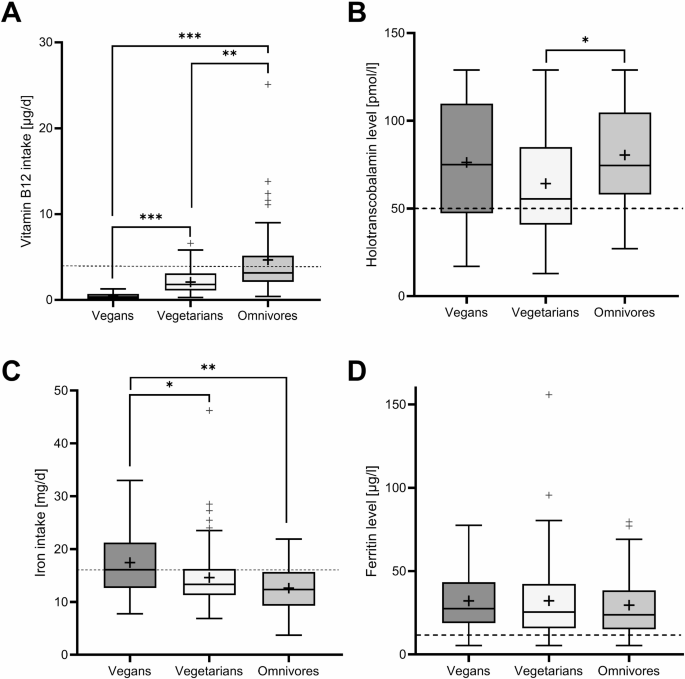
Blood samples were collected after an overnight fast (≥ 10 h) between 06:30 a.m. and 10:00 a.m. Vitamin B12 status was assessed by analyzing serum holotranscobalamin (HTC) immunologically via a chemiluminescence microparticle assay. Iron status was assessed by analyzing serum ferritin using an immunoturbidimetric method. The analysis of all blood parameters was performed in an accredited and certified laboratory (Labor Dr. Krause & Kollegen MVZ GmbH, Kiel, Germany).
Lifestyle data
A study-specific online questionnaire was used to collect sociodemographic data, including sex, age upon study participation, duration and reason for the choice of dietary pattern, smoking status, income (including the share of food expenditure), and whether they used dietary supplements (particularly vitamin B12 and iron supplements).
Dietary data
Participants self-recorded their dietary habits using dietary records for three consecutive days, including one weekend day. They were instructed to document the following information for all consumed food products and beverages: time and place of consumption (to assess out-of-home consumption), brand and product name, as well as preparation instructions. All food quantities were weighted or estimated by the participants in grams or household measures. Daily macro- and micronutrient intakes were calculated using the nutrition software PRODI® 6.11 (Nutri-Science GmbH, Freiburg, Germany). The German Nutrient Database (BLS, Bundeslebensmittelschlüssel) Version 3.02 was used to evaluate unprocessed foods such as fruit and vegetables, but also for some processed foods such as bread, cheese, and canned goods. For most processed food products, recipes based on the manufacturer’s information had to be created by hand, as most were not included in the BLS. The ingredients listed in those recipes were based on information from the BLS in order to assess the nutrients of all ingredients (in particular, micronutrients). In case of incomplete product information, equivalent food products from the BLS were used or, if not available, comparable products from other manufacturers. Standardized recipes were developed for composite foods and dishes not described sufficiently to identify all ingredients and intake quantity. This applied to most takeaway or restaurant dishes and some homemade dishes without further details. The Dietary Reference Intake values of the German Society for Nutrition18 were used to evaluate nutrient intake. No underreporting was observed according to Willet’s criteria (> 500 kcal/d for females and > 800 kcal/d for males). This may be due to the exclusion of incomplete dietary records (< 3 days) and the intensive support provided during the protocol phase.
Level of food processing
All reported food items were categorized according to the extent and purpose of food processing following the NOVA classification system19. This system differentiates between four food groups: 1. unprocessed and low-processed foods, 2. culinary ingredients, 3. processed foods, and 4. ultra-processed foods (UPF). In order to minimize errors, two researchers and one dietitian conducted a consensus-based classification process based on the recommendations of Martínez-Steele et al.20. Therefore, a list of all consumed food products was compiled, with single-ingredient foods classified as NOVA 1 or 2. Multi-ingredient food products that were clearly industrially manufactured were assigned to NOVA 4. Accuracy of classification was improved by using available information like the brand and product name (ingredient list), the preparation method (e.g., homemade, takeaway, restaurant), or certain key phrases in the food product description (e.g., fresh, unpackaged, ready-made, instant). For any remaining uncertainty, the food product was assigned to the most likely NOVA group based on the majority of other participants’ responses, findings from other studies, or else, the product was systematically assigned to the lower NOVA group. These food products were flagged for sensitivity analysis to calculate a lower and upper NOVA distribution range representing inter-rater agreement.
Qualitative aspects of the diet were determined by analyzing the contribution of each NOVA food group to the daily absolute and relative intake of energy, protein, SFA, sugar, and fiber, as well as vitamin B2, vitamin B12, folate, iron, zinc, and calcium. In order to compare qualitative aspects of consumed foods (food level) between NOVA food groups 3 and 4, the average content of macronutrients is given as the energy percentage of food, and the micronutrient content is given as 100 g of food. By assessing both qualitative aspects of the diet and foods, we are able to detect if a lower nutrient content of NOVA 4 foods may be compensated by a higher intake of these products, which results in an overall sufficient nutrient intake.
Classification of plant-based alternatives
Products mimicking meat or dairy were defined as plant-based alternatives. Tofu or seitan in their original form were also included in this category as they are often used as meat alternatives in Western diets. Whenever possible, the plant-based alternatives were categorized according to NOVA based on the ingredient information. If brand information was missing, meat alternatives were classified as ultra-processed19,20. Plant-based milk alternatives with missing brand information were assigned to NOVA 3 following the best practice approach of Martinez-Steele et al. (77% of reported plant-based milk alternatives were not ultra-processed)20. Plant-based yogurt, cream, and cheese alternatives were categorized more frequently as ultra-processed, which is why NOVA 4 was chosen in cases of missing brand information.
The contribution of plant-based alternatives to qualitative aspects of the diet was calculated overall and within the different diet groups by analyzing their contribution to total dietary intake of energy, protein, SFA, sugar, and fiber, as well as vitamin B2, vitamin B12, folate, iron, zinc, and calcium. In order to compare qualitative aspects of plant-based alternative products (categorized into meat alternatives and dairy alternatives) with qualitative aspects of milk and dairy products, the average content of macronutrients is given as energy percentage of food, and the micronutrient content is given as 100 g of food.
Statistical analysis
Statistical analyses were conducted using IBM SPSS Statistics© (SPSS 28.0, Inc., Chicago, IL, USA) with the significance level set at p < 0.05. Normal distribution of data was rejected using the Kolmogorov–Smirnov test, and the data are presented as medians and interquartile ranges. Differences between diet groups regarding basal characteristics, daily intake of macro- and micronutrients, blood parameters, as well as the contribution of plant-based alternatives to qualitative aspects of the diet were examined using the Kruskal–Wallis test with the Bonferroni post-hoc test for metric variables and chi-square test with pairwise comparison for categorical variables. Daily intake of various micronutrients was compared between tertiles of UPF consumption, and p-values were obtained using the Kruskal–Wallis test with the Bonferroni post-hoc test. Spearman’s correlation coefficients were computed to determine the impact of UPF consumption on BMI and FMI. To assess qualitative differences between NOVA 3 and NOVA 4 food products, an unpaired two-sided Welch t-test was conducted due to large group sizes. These data are presented as mean ± SD. Graphs were plotted using GraphPad Prism 10.2.2 (GraphPad Prism for Windows, GraphPad Software, La Jolla, California, USA).